
Orchestras and symphonies paint a vivid picture of musicians skillfully playing stringed instruments, with violins often taking center stage. Positioned at the front, they move together to deliver harmony or guide the performance seamlessly.
String instruments, or chordophones, fall under one of the four categories in the Hornbostel-Sachs scheme. These instruments produce sound by stretching, plucking, or bowing strings to create vibrations.
At a Glance: String Instruments
- Core Instruments: The primary string instruments in an orchestra include the violin, viola, cello, and double bass.
- Techniques: Players use various techniques such as bowing, plucking (pizzicato), and strumming with a plectrum to produce sound.
- Construction: String instruments rely on their shape, type of wood, and strings’ characteristics, including thickness and tension, to create different pitches and tones.
- Sound Production: Vibrations from the strings are transmitted through the bridge to the body of the instrument, amplifying the sound via the soundbox.
- Variations: String instruments come in various forms across cultures, such as the sitar in India, rebab in Muslim countries, and banjo with African origins.
The instruments below are some of the most experienced options for advanced ensembles. Some early symphonic music is even composed exclusively for them. The harp and piano are well-established in the string family, depending on the era when the music was played.
What is the Stringed Instrument?
String instruments fall into subcategories: bowed instruments such as the violin, viola, cello, and double bass, as well as viols, gambas, and fiddles, which were popular during the Baroque period and in diverse folk music.
These instruments can be plucked with fingers, a technique called pizzicato. Techniques include using a plectrum, also known as a pick, for strumming or tapping on the fingerboard to create vibrations electronically amplified for a sustained sound. A plectrum is a small flat tool, often made of plastic, used to pluck or strum stringed instruments like guitars or mandolins.
Stringed instruments that are mainly plucked include the harp and electric bass. Many cultures also have unique chordophones, such as the sitar in India, rebab in Muslim countries, banjo with African roots, mandolin from Italy, ukulele in Hawaii, and bouzouki in Greece.
We typically see five types of stringed instruments in orchestras. However, contemporary and global music genres have changed this traditional lineup.
How Do String Instruments Work?
The violin is the most commonly used string instrument, followed by the viola, cello, and double bass.
These four instruments are built by joining pieces of wood into a hollow box where the sound rings out. There is more to it than that, though. A string instrument’s tone depends on its shape, the kind of wood, how thick that wood is, and the varnish on top. The thickness, length, and tightness of the strings also do a lot to shape the pitch.
Creating sound with stringed instruments involves vibrations from strumming, plucking, or bowing. These vibrations move from the strings to the bridge and then to the soundbox. Inside the soundbox, air particles vibrate, amplifying the sounds for the audience and musicians.
A musician can create sound or a harmonic sequence by plucking, strumming, stretching, or using tools like a hammer or bow. They might even combine these actions.
String Instruments List With Pictures
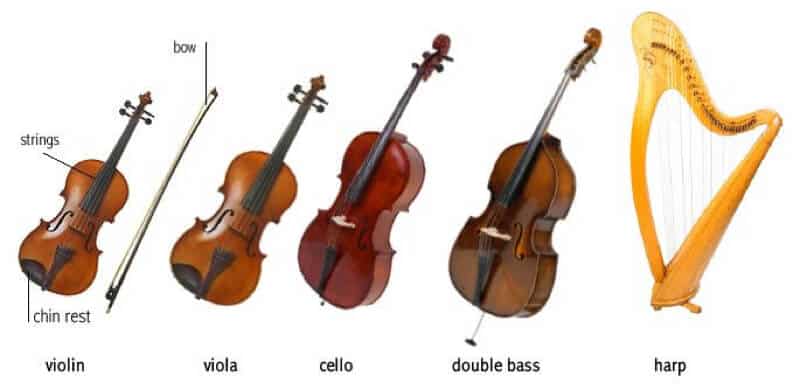
To identify them on stage, look first at size and position. The violin and slightly larger viola rest under the chin, while the seated cellist holds a larger instrument between the knees. The double bass is taller still and is played standing or on a high stool. The harp has a tall triangular frame and exposed strings that the player plucks. In general, the larger bowed instruments cover lower registers, though their ranges overlap.
1) Violin

The violin, the most popular string instrument, is often called the soprano or the “star” of the orchestra. It leads the symphony and plays the most notes annually.
The violin, often called the “fiddle“, evolved from the medieval fiddle to the Renaissance era. It’s the smallest and highest-pitched member of the string family. The body of a full-sized violin is about 14 inches long, but smaller versions like ½, ¾, and 7/8 are available for children, as their fingers can’t reach all positions on a standard-sized instrument.
String instruments dominate many classical pieces. An orchestra might need at least 30 violinists, split into two groups with distinct roles: first and second violins. First violins often carry the melody, while second violins may play harmony, accompaniment or a melody of their own.
2) Viola

In an orchestra, violas are the middle tone or Alto. Shaped like a violin but larger, they produce a deeper, warmer voice.
The violin and viola share similar playing techniques like bowing and plucking, along with the same tuning principles. Both instruments rest on the chin, neck, and shoulder, with the left hand for fingering notes and the right for holding the bow. Manufacturers also make versions for left-handed players.
The viola’s open strings are tuned C3, G3, D4, and A4, from low to high. In an orchestra, 10-14 violists usually form a group. While violas typically play harmony, many composers have written solo parts to highlight its rich and warm tones.
3) Cello

The cello, or violoncello, is a bowed instrument. It’s much larger than the violin and viola, about 4 feet long. Due to its size, you play it upright, supported by a steel peg, placed between your knees, with the neck resting on your shoulder. This setup means you play it while sitting.
Like the violin and viola, the cello normally has four strings, but its larger body rests on an endpin. This instrument closely matches the tone of the human voice. Ensembles typically feature eight to 12 cellists, playing both harmony and melody.
4) Double Bass

The double bass, the largest instrument in the String family and orchestras, stands over six feet tall. Played upright like a cello, musicians sometimes use a stool for support. In classical music, it’s bowed. In various genres, its unique sound from percussion-like techniques makes it popular.
The double bass has a lower register than the cello and provides a deep foundation for the ensemble. When the two sections play the same written bass line, the bass typically sounds an octave lower. For this reason, it’s an essential instrument in an orchestra.
The double bass is also the odd one out when it comes to tuning. Its four strings are usually set in fourths (E, A, D, G), while the violin, viola, and cello are all tuned in fifths.
It’s like a cello, but much bigger. Players stand or use a high stool, and instruments come in different sizes. Generally, there are 6-8 double basses playing harmony.
With its rich pitch and diverse tones, the bass has gained popularity beyond classical music. It’s a key instrument in jazz bands and widely used in popular music. While often played with a bow like the cello, violin, and viola, jazz bass players prefer plucking the strings. In jazz, the double bass handles both harmony and melody.
5) Harp
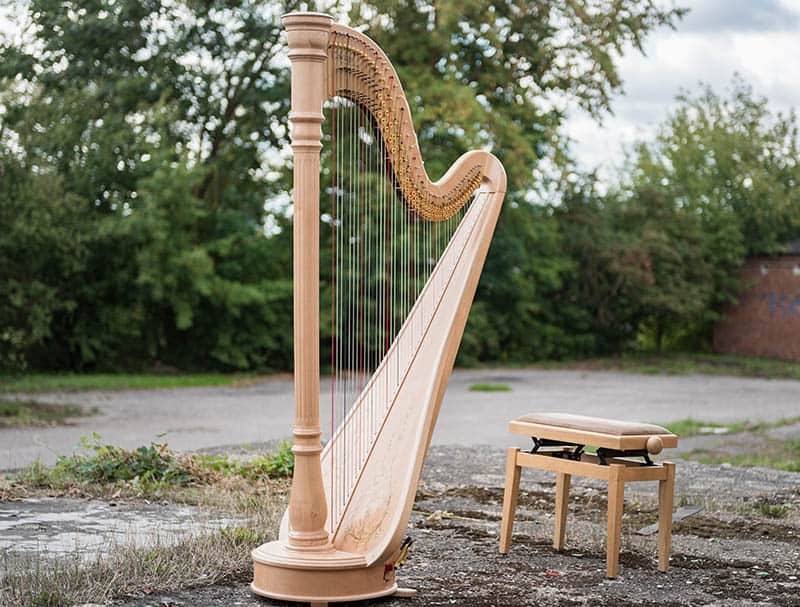
Unlike the bowed strings, the concert harp has a large triangular frame and 47 strings that are plucked or strummed. Its seven foot pedals change the pitches of the strings.
The pedals allow the harpist to change notes for different keys without retuning each string by hand.
Harps stand as tall as a double bass at around six feet. Harpists play the instrument by sitting and positioning it opposite them, plucking the strings. Despite their subtle role in symphonies, crowds recognize the harp’s soothing and heavenly sound.
The harp is probably one of the earliest instruments in human history. It’s mentioned in classical literature and poetry, such as the lyre from Greek Mythology’s Orpheus. Many ancient Egyptian artworks also depict the harp in ceremonies. Over the centuries, the harp hasn’t changed much in its basic principle, and it’s still played by plucking.
The modern concert harp, which took shape a couple of centuries ago, appears in orchestral works that call for it. Its distinctive build and graceful tone color give performances a texture nothing else quite matches.