
A roll-up piano puts a keyboard layout on a flexible silicone mat. It is handy for a musical toy, checking notes or packing light, but the flat keys do not develop the touch you need on an acoustic piano.
My top recommendation is the MUKIKIM Rock And Roll It Piano Studio (61 Keys). Its documented MIDI connection, recording features and rechargeable power make it the most useful all-round option in this shortlist.
For a child starting with musical play, the MUKIKIM Rock And Roll It Rainbow Piano (49 Keys) is my budget choice. Its 49 colored keys work with the included color songbook.
The 3 Best Roll-Up Piano Keyboards (2026)
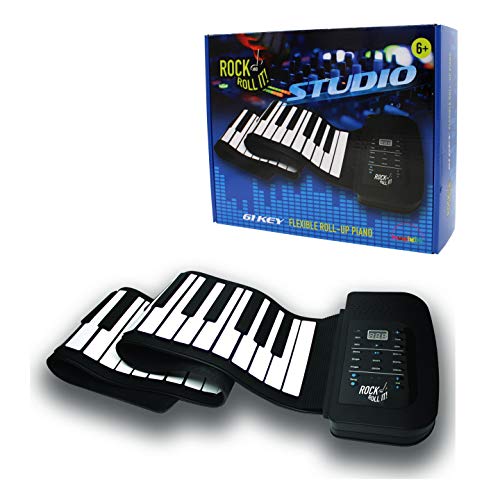
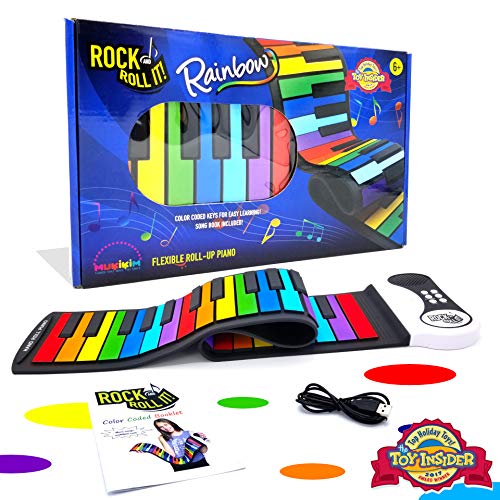
1. MUKIKIM Rock And Roll It Piano Studio (61 Keys)
Pros
- 61 standard-size keys
- MIDI connection and record/playback
- Built-in speaker and headphone output
Cons
- Flexible surface does not feel like moving piano keys
The MUKIKIM Piano Studio is my main choice for a roll-up keyboard. Its 61-key layout provides more room than the smaller Rainbow model while keeping the mat easy to pack. I would use it for working out a melody or exploring sounds when a rigid keyboard is impractical.
MUKIKIM specifies 128 tones, 128 rhythms and 45 demonstration songs. The recording feature lets you play a short idea back, and its built-in speaker means you do not have to connect a separate sound system. The headphone output is useful in a shared room.
The Studio can run from its rechargeable battery or USB power. It also supports MIDI, giving it a use beyond its internal sounds when connected to compatible software. Check the connection requirements of your computer or tablet before choosing it for that purpose.
This is still a silicone playing surface. It can show you the position of notes, but it cannot reproduce weighted-key resistance, key travel or acoustic-piano control. Choose it for compactness, then use a conventional keyboard for your main lessons.
2. MUKIKIM Rock And Roll It Rainbow Piano (49 Keys)
Pros
- 49 color-coded keys
- Play-by-color songbook included
- Compact format for children
Cons
- Smaller range and no conventional piano key action
The MUKIKIM Rainbow Piano is the simpler choice for a child who wants to explore a keyboard. Its colored keys match the included play-by-color songbook, so a beginner can follow the sequence of colors before learning staff notation.
There are 49 keys rather than the Studio model’s 61. That shorter mat is easier to fit on a small table, although it restricts pieces that use a wider range. Make sure it has a firm, flat surface underneath; a roll-up keyboard needs support while being played.
MUKIKIM describes multiple tones, demonstration songs, echo and sustain functions, recording and playback, and a built-in speaker. It can use USB power or batteries. These features suit musical play without requiring a computer or external speaker.
I would pick the Rainbow as a first musical toy or a gift for a younger child. Its colored layout is the main reason to choose it. For someone already following regular piano lessons, a keyboard with moving keys is the more useful long-term purchase.
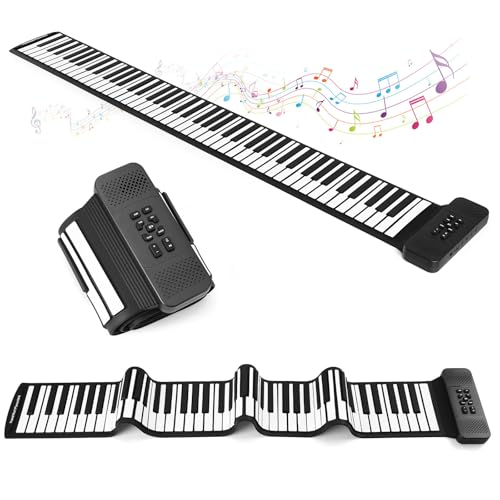
Pros
- 88-key note range
- Rechargeable power
- Headphone output for quiet playing
Cons
- Full note range does not provide an acoustic piano touch
The Lujex 88-key model remains useful when your priority is having the full piano range in a roll-up mat. It occupies more space when laid out than either MUKIKIM, so measure the table you intend to use rather than judging it only by its packed size.
Lujex lists 128 tones, a rechargeable battery and a headphone connection. Those are useful practical features for a portable keyboard. I would choose it for finding notes across a wide range or experimenting with a melody away from home.
The 88-key label describes the number of notes. It does not establish weighted action, touch sensitivity or a particular maximum chord size. Avoid choosing it simply because a full-size acoustic piano also has 88 keys.
Choose the Lujex for its 88-note range and rechargeable design. The Piano Studio remains my first choice when MIDI and record/playback are the priority.
Are Roll-Up Pianos Good for Learning?
A roll-up piano can help a beginner recognize note names and keyboard patterns, but it is a limited substitute for a conventional keyboard. The fingers press a flat pad rather than controlling the travel of individual keys. That difference matters when learning evenness, dynamics and relaxed technique.
For regular lessons, prioritize a stable keyboard with moving keys. If you already have one at home, a roll-up mat can be a secondary travel tool. Keep the exercises simple and do not assume a mat will respond to chords and repeated notes in the same way as your main instrument.
What Should You Check Before Buying?
Choose the key range for the music you actually want to play. A child following a color songbook may be happier with the Rainbow’s 49 keys; someone checking longer melodies or connecting music software has a clearer reason to choose the Studio. An 88-key mat needs considerably more desk space.
Check how the exact model is powered and which connections it provides. USB power, USB MIDI and Bluetooth are separate features, so a USB socket alone does not prove that a keyboard can control music software. A headphone output is particularly useful for a portable instrument used around other people.
Summary
Choose the MUKIKIM Rock And Roll It Piano Studio (61 Keys) for the broadest useful feature set here. The MUKIKIM Rock And Roll It Rainbow Piano (49 Keys) is a simpler child-focused choice, while the Lujex suits buyers who specifically need 88 notes in a roll-up mat.