
EQ pedals help you shape the tone of an amplified instrument. Whether you’re using a guitar, bass guitar, or any other instrument, they let you cut or boost specific frequencies to fine-tune, shape, and define your sound.
An EQ pedal gives guitarists and bassists more control over their sound when their existing controls do not cover the frequencies they want to change.
My top pick for guitarists seeking an EQ pedal is MXR M108S Ten Band EQ. It offers extensive control over ten frequency bands to shape your sound precisely.
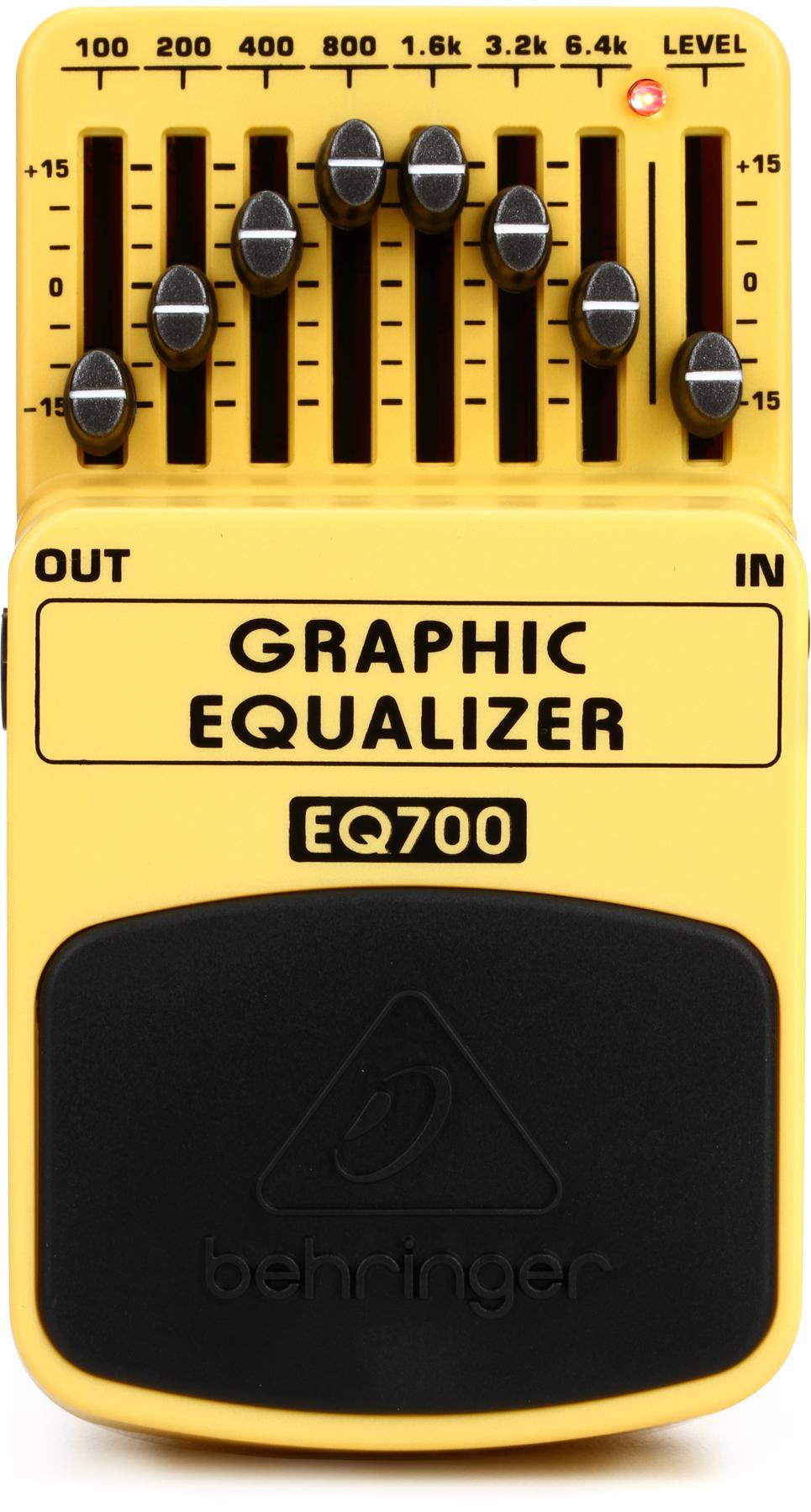
For a budget pick, consider the Behringer EQ700. It’s a great 7-band EQ with an excellent value-for-money ratio.
The 7 Best EQ Pedals for Guitar and Bass (2026)




Let’s compare them in more detail:
1. MXR M108S Ten Band EQ
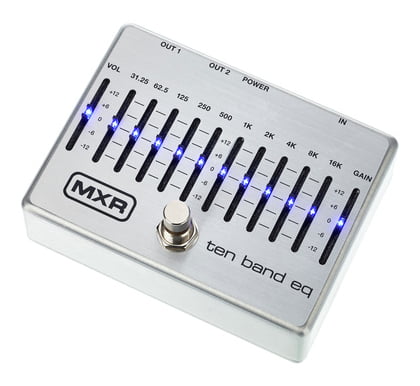
My top EQ pedal is the MXR M108S Ten Band EQ. It’s a versatile graphic EQ with excellent noise reduction, a true bypass switch, lightweight aluminum case, ten EQ bands, and volume gain adjustment slides.
Pros
- Ten-band EQ with up to 12dB boost
- Great extra features
- Natural sound and great noise-reduction circuitry
- Dual outputs for 2 different signal chains
Cons
- Needs an 18 V power supply rather than a standard 9 V output
The ten bands range from 31.25 Hz to 16 kHz, with the option to boost or cut up to 12 dB. This provides users with precise sound control. Additionally, the MXR M108S offers dual outputs for two distinct signal chains.
The illuminated sliders help you see the curve on a dark stage. Its power requirement deserves more attention: the M108S uses 18 V DC, so check your pedalboard supply or use the included adapter. The two outputs carry the same equalized signal; they do not provide two independent EQ curves.
| Frequencies | 31.25 Hz, 62.5 Hz, 125 Hz, 250 Hz, 500 Hz, 1 kHz, 2 kHz, 4 kHz, 8 kHz, 16 kHz |
| Controls – Switches | 10 band sliders, 1 master level, 1 gain – True Bypass |
| Input | 1 x 1/4″ |
| Output | 2 x 1/4″ |
| Type | Graphic |
| Ease Of Use | Easy |
The MXR M108S is a superior ten-band EQ packed with extra features, ideal for guitarists and bassists wanting to shape their sound as desired.
The separate gain and volume sliders make it easier to distinguish how hard you drive the EQ from how loud its output is. The 31.25 Hz and 62.5 Hz bands give bass players controls below the range of most compact guitar EQs. Start with small cuts or boosts, especially in those lowest bands; more boost is not automatically a clearer sound.
2. Behringer EQ700
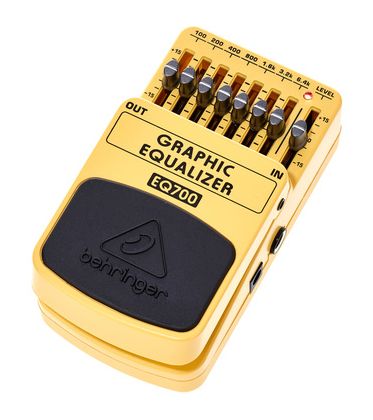
Behringer EQ700 is a top choice for beginners, offering an affordable alternative to the iconic Boss GE-7 EQ pedal. With 7 frequency sliders from 100 Hz to 6.4 kHz and up to 15 dB boost or cut, it gives guitarists significant control over their sound.
Pros
- Great value for the price
- Wide range of adjustment options
- Affordable
Cons
- No preset recall or adjustable band width
EQ700 has a volume slider and an LED to show if the pedal is active or the battery status. It’s ideal for guitarists, while the BEQ700 is designed for bass players.
The EQ700 keeps the controls simple: seven fixed frequency bands and one output-level slider. There are no presets, MIDI connections or adjustable band widths. Large boosts can also emphasize noise already present in your rig, so begin near the center positions and compare the engaged level with bypass.
| Frequencies | 100 Hz, 200 Hz, 400 Hz, 800 Hz, 1.6 kHz, 3.2 kHz, 6.4 kHz |
| Controls – Switches | 7 band sliders, 1 master level – On/Off |
| Input | 1 x 1/4″ |
| Output | 1 x 1/4″ |
| Type | Graphic |
| Ease Of Use | Easy |
Overall, the Behringer EQ700 is a great pedal considering its price. If you’re a beginner guitarist searching for an easy-to-use EQ pedal, this one works well.
Its lowest slider is 100 Hz, making it a practical choice for guitar midrange shaping rather than detailed control of a bass guitar’s deepest fundamentals. The separate BEQ700 is worth comparing for a bass-focused setup. The EQ700 remains the budget guitar option here; it does not acquire the bass model’s frequency layout simply because both have seven sliders.
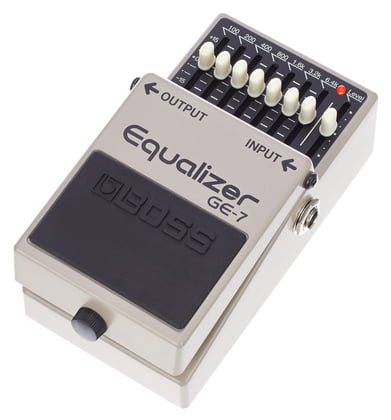
3. BOSS GE-7
Boss guitar pedals are iconic. The Boss GE-7 stands out as a highly-used equalizer pedal. Featuring a 7-band equalizer, it allows for adjustments from -15 dB to +15 dB. An independent level slider adjusts overall output by up to 15 dB in either direction.
Pros
- Wide range of adjustment options
- Solid build quality
- Independent level control
- Easy to use
Cons
- Does not have many features
The Boss GE-7 has a sturdy aluminum stompbox with the traditional Boss design and is an easy-to-use EQ pedal. While it doesn’t have many features, it accomplishes its tasks effectively. It lets you adjust frequencies between 100 Hz and 6.4 kHz.
This pedal’s for guitars, but Boss also offers the GEB-7, a Bass Equalizer version.
Choose the GE-7 when you want to see and change a guitar EQ curve immediately, with no menu or preset preparation. Its level slider can bring the changed tone back to the bypass volume or create a deliberate solo lift. The GEB-7 has a different frequency layout for bass; it is an alternative to investigate for that use, not a newer version of the same pedal.
| Frequencies | 100 Hz, 200 Hz, 400 Hz, 800 Hz, 1.6 kHz, 3.2 kHz, 6.4 kHz |
| Controls – Switches | 7 band sliders, 1 master level, On/Off |
| Input | 1 x 1/4″ |
| Output | 1 x 1/4″ |
| Type | Graphic |
| Ease Of Use | Easy |
You’ll find many clones of the Boss GE-7 because it’s an industry-standard pedal like many other Boss products. If you want a simple yet high-quality EQ pedal, you can’t go wrong with the Boss GE-7.
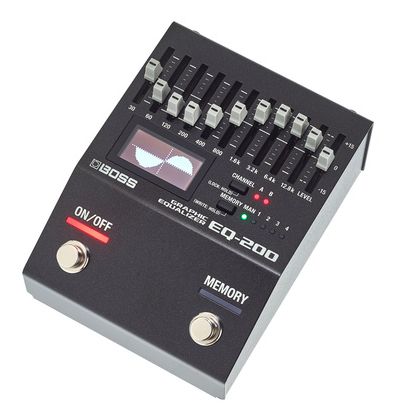
4. BOSS EQ-200
Boss EQ-200 stands out as a highly versatile EQ pedal. With 10-band frequency adjustments, 127 stored memories plus the live panel setting on firmware version 1.1 or later, an EQ recall feature, and an option for either two mono signals or one stereo signal, it simplifies the process with its intuitive graphic display.
Pros
- 2 highly adjustable 10-band EQs in one
- Feature-packed
- Eq recall feature
- External switches, an expression pedal, and MIDI connectivity
Cons
- A bit pricey
The two 10-band EQ channels handle two signals or stereo channels separately. You can boost or cut frequencies up to 15dB and choose from three ranges: 28 Hz to 14 kHz, 30 Hz to 12.8 kHz, and 32 Hz to 16 kHz.
The EQ-200 offers various connectivity options like MIDI in/out, a jack input for external switches or expression pedals, and a micro-USB port for computer updates. A controller and MIDI expand live recall options, but the pedal also works on its own with its onboard controls and footswitches.
| Frequencies | 30 Hz, 60 Hz, 120 Hz, 200 Hz, 400 Hz, 800Hz, 1.6 kHz, 3.2kHz, 6.4 kHz, 12.8kHz |
| Controls – Switches | 10 band sliders, 1 master level, Channel, Memory – On/Off, Memory Switch |
| Input | 2 x 1/4″ |
| Output | 2 x 1/4″ |
| Type | Graphic |
| Ease Of Use | Medium |
Though not the cheapest, the Boss EQ-200 is an excellent choice for guitarists and bassists wanting a feature-packed advanced EQ pedal for complete control.
The physical sliders are its clearest advantage over compact encoder-based EQs. You can use the two paths in stereo or place an external pedal between them for different shaping before and after that effect. Check the installed firmware before planning a large preset library. The displayed curve represents the selected channel, so confirm which channel you are editing before moving a slider.

5. Source Audio EQ2 Programmable Equalizer
Source Audio EQ2 Programmable Equalizer suits guitarists and bassists who need several repeatable tones from a small pedal. It combines ten editable bands with two EQ paths, stereo inputs and outputs, preset recall, and a built-in tuner. It earns its place through flexible frequency selection and compact routing rather than a large bank of physical sliders.
Pros
- Movable band frequencies and adjustable bandwidth
- Stereo routing and repeatable preset recall
- Tuner plus optional gate and limiter
Cons
- Encoder and software editing need preparation
- No battery operation or dedicated analog compressor
Each band can be moved between 20 Hz and 20 kHz, with adjustable bandwidth and up to 18 dB of cut or boost. That lets you target a narrow troublesome frequency or make a broader tonal change. You can save different curves for instruments or songs instead of trying to recreate the same settings by eye at every rehearsal.
The pedal provides four onboard presets, or eight in Preset Extension Mode, and a library of 128 presets accessible through its encoder or MIDI. Neuro 3 software adds deeper editing and routing. Optional gate and limiter functions can be configured there, but they do not make the EQ2 an analog compressor or remove noise from every possible rig.
Its single encoder keeps the footprint small, with a corresponding cost in immediacy: changing several bands during a soundcheck takes more navigation than moving the EQ-200’s sliders. Prepare the curves and footswitch behavior ahead of a performance. Choose the BOSS if your priority is seeing and changing a whole curve directly on the pedal.
The EQ2 suits players who want programmable EQ and flexible routing in a compact pedal. Anyone specifically seeking Zenith’s analog EQ, compression and boost combination should check that model’s current purchase options rather than expecting the EQ2 to reproduce its compressor workflow.
| EQ | Ten adjustable bands, ±18 dB |
| Frequency selection | 20 Hz to 20 kHz |
| Presets | 4 onboard; 8 in extension mode; 128 stored |
| Audio connections | Two 1/4-inch inputs and two outputs |
| Power | 9 V DC, center negative; no battery |
| Interface | Encoder, Select/Save button, MIDI and Neuro software |
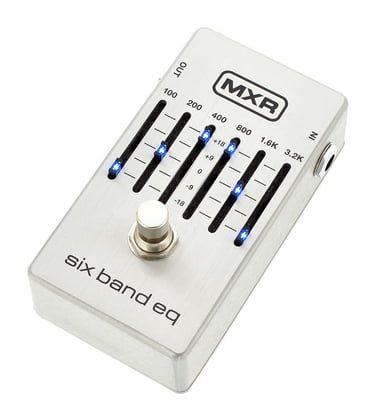
6. MXR M109S Six Band EQ
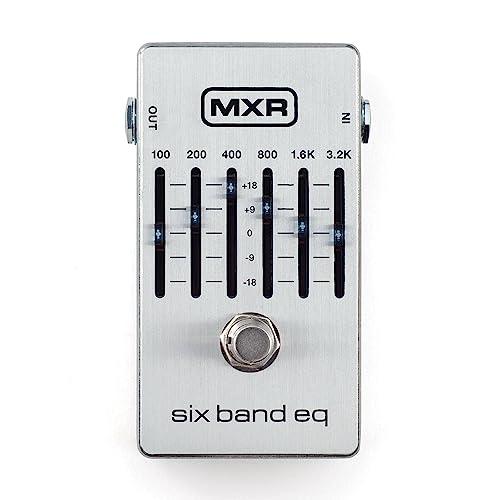
MXR M109S Six Band EQ is a smaller, more affordable version of my top pick, the MXR M108S Ten Band EQ. While it has four fewer frequency bands and fewer features, its sound quality and excellent noise reduction make it a standout choice for guitarists seeking a straightforward, high-quality EQ pedal.
Pros
- Great value for the price
- Natural sound and great noise-reduction circuitry
- Wide range of adjustment options up to 18 dB boost
Cons
- No master volume or gain adjustments
- Less deep-bass control than the ten-band model
The MXR M109S Six Band EQ offers a smooth, natural sound and an impressive 18 dB boost range, making it a great value. It even allows more boost than its larger counterpart. However, the absence of master level and gain volume knobs might be a drawback for some guitarists.
Bass players seeking dedicated controls below 100 Hz should compare the MXR M108S Ten Band EQ. The M109S can still shape a bass’s midrange, but its six bands stop at 100 Hz at the low end. Guitarists who mainly need midrange adjustments may prefer its smaller footprint and 9 V power requirement.
| Frequencies | 100 Hz, 200 Hz, 400 Hz, 800 Hz, 1.6 kHz, 3.2 kHz |
| Controls – Switches | 6 band sliders – True Bypass |
| Input | 1 x 1/4″ |
| Output | 1 x 1/4″ |
| Type | Graphic |
| Ease Of Use | Easy |
MXR M109S Six Band EQ is a great choice for guitarists seeking a high-quality, natural-sounding, and straightforward EQ pedal.
The missing master-level slider is the main practical limitation. Moving several bands upward also changes the overall signal level, and there is no separate output slider to compensate. A guitar player who wants a clear, repeatable solo-volume boost may find the GE-7 or ten-band MXR easier to balance. For small corrective cuts in an otherwise settled rig, the six-band layout stays straightforward.
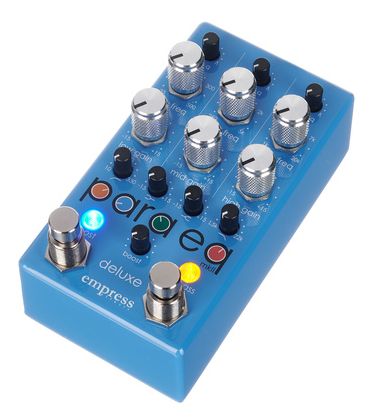
7. Empress ParaEQ MKII Deluxe
Empress ParaEQ MKII Deluxe is the analog choice for players who want to select the problem frequency and the width of the correction. Its three parametric bands each have gain, frequency and bandwidth controls. The Deluxe also adds low and high shelving controls, pass filters, and a separate boost footswitch.
Pros
- Three fully parametric bands with continuously adjustable bandwidth
- Additional shelves and high/low-pass filters
- Separate boost footswitch
Cons
- No XLR DI output or preset memory
- Several interacting controls require careful setup
- Needs an adequate external power supply
This approach is useful when a fixed graphic-EQ slider falls on the wrong frequency. A narrow cut can address a localized resonance, while a wider setting changes a larger part of the instrument’s tone. Each parametric band offers up to 15 dB of cut or boost. Begin with the gain near neutral, then adjust frequency and bandwidth before making a large level change.
The shelving controls handle broad bass and treble balance, while the high-pass and low-pass filters trim frequencies beyond the range you want to retain. The separate clean boost provides up to 30 dB when a deliberate level lift is needed. How that boost affects the sound still depends on the headroom of the equipment that follows it.
The circuit runs internally at 27 V, but the external power input is 9 V DC, center negative, requiring a supply capable of at least 300 mA. Do not connect a 27 V adapter. The Deluxe is also distinct from the standard ParaEQ MKII, which does not have this same set of continuously variable bandwidth, shelf and filter controls.
The Deluxe suits players who want detailed analog tone shaping and a separate boost. It is not a direct DI replacement: there is no balanced XLR output, phantom-power operation or preset recall. If you need a direct feed to a church mixer or recording interface, plan a suitable separate DI. Guitarists and bassists who want repeatable presets should instead compare the EQ-200 or EQ2.
| EQ | Three parametric bands, ±15 dB; low/high shelves |
| Filters | High-pass and low-pass |
| Boost | Up to 30 dB with separate footswitch |
| Connections | One 1/4-inch input and one output |
| Power input | 9 V DC, center negative, minimum 300 mA |
| Bypass | Selectable true or buffered |
What is an EQ pedal?
Simply put, an EQ or an equalizer pedal lets you cut or boost specific frequency ranges. This allows you to balance your instrument’s sound by adjusting the relative amplitudes of the frequencies in the signal.
There are various EQ pedals available. Some target a single frequency like mids, while others let you adjust 10 frequency bands. Common options include 3-band, 5-band, 6-band, 7-band, and 10-band equalizer pedals.
Three key factors in equalization are frequencies, Q (quality factor), and gain. Frequencies, measured in Hertz, represent different tones in the audio spectrum. Q indicates how sharp or broad the cut or boost is. Gain refers to the power level of the cut or boost.
What types of EQ pedals are there?
There are 3 types of EQ pedals: Graphic EQ, Parametric EQ, and Semi-Parametric EQ.
Graphic EQ pedals are popular due to their graphic-shaped interfaces. They feature multiple frequency bands controlled by amplitude sliders, allowing you to boost or cut specific frequencies.
Users can easily control the pedal by visualizing the EQ curve. While some pedals might include gain and master volume controls, they lack Q control.
Parametric EQ pedals offer total control over equalization. They have knobs to boost or cut frequency bands and adjust the Q value.
Parametric EQ pedals let users adjust center frequencies to either cut or boost. They usually include gain and master-level knobs, along with extra features.
Semi-parametric EQ offers some features of a parametric EQ. Typically, it includes fixed bass and treble frequency knobs and a sweepable Mid adjustment with Q control. Another type of Semi-Parametric EQ has the features of Parametric EQ pedals but lacks Q control.
What to look out for when buying an EQ pedal?
Buying an EQ pedal involves considering the EQ type, number of frequency bands, extra features, and price.
Think about which type of EQ suits your needs. Graphic EQ pedals are the most common and easiest to use, perfect for beginners seeking simplicity. Parametric and Semi-Parametric EQ pedals offer more control over your sound, but you’ll need some musical knowledge to use them effectively.
Decide how many bands you need on your EQ pedal. Guitar EQ pedals often have 6 to 10 bands and are usually graphic type. More bands give you greater control over your tone.
Consider the features of the EQ pedal you’re eyeing. A master level and gain adjustment knob or slider can offer more control over your tone. Also, connectivity options add versatility to the pedal.
Price is crucial for many. Calculate your budget and leave room for other gear. Spending everything on an EQ pedal isn’t wise. Prioritize cost efficiency over extra features if on a tight budget.
Can an EQ pedal be used for both a guitar and a bass guitar?
Yes, many pedals give you control over a wide range of low-end and mid-frequencies, crucial for bass guitars and guitars. Boss EQ-200, Empress ParaEQ MKII Deluxe, Source Audio EQ2, and MXR M108S are great examples of these EQ pedals.
Is an EQ pedal essential for pedal setups?
EQ pedals can be useful for guitarists and bassists who need more targeted tone controls. While some pedals and amplifiers have EQ controls, dedicated EQ pedals offer greater versatility and control over your sound.
EQ pedals let you cut unwanted frequencies and boost missing ones. They can serve as booster pedals to help you stand out in solos. You can also adjust and shape tone by placing them differently in the signal chain. For instance, placing an EQ in a compatible amplifier effects loop and reducing highs and lows can create a narrow, radio-like tone. Never connect a normal pedal to an amplifier’s speaker output.
Shape your sound with a dedicated EQ pedal when your amplifier’s controls do not target the frequencies you want to adjust. An amp’s tone stack and a pedal’s EQ may interact, and both active and passive amplifier designs exist. An extra pedal is optional: keep it only if it solves a tonal or switching need in your own setup.
Summary
EQ pedals are versatile additions to a pedalboard when more precise tone shaping is useful. Shaping your tone by cutting or boosting specific frequencies is vital for a professional sound and avoiding unwanted noise.
My top pick is the MXR M108S Ten Band EQ, offering guitarists and bassists control over 10 frequency bands, plus added features and superior sound quality.
If you’re looking for an affordable EQ pedal, I’d recommend the Behringer EQ700. It has a simple layout and allows you to control 7 bands of frequencies, making it a great budget choice. Behringer EQ700