
A guitar headphone amp takes your instrument signal and adds an amp-like sound for quiet practice. Choose a simple plug-in model for quick playing, a USB modeler for recording and editing, or an integrated wireless system if you want the headphones and transmitter together.
Guitar Headphone Amplifiers allow you to experiment with your musical compositions as long as you like, without the fear of disturbing other’s peace. It is specifically valuable for raw musicians who want to freely mess around with their tunes.
My top recommended guitar headphone amp is the Fender Mustang Micro Plus. This is an extremely versatile and popular option from a renowned company.
My second recommended guitar headphone amp is the NUX GP-1. This is a nifty, budget-friendly option with solid battery life for quiet practice sessions.
The 7 Best Guitar Headphone Amps (2026)


Let’s compare these in more detail.
1. Fender Mustang Micro Plus
Fender Mustang Micro Plus is my first choice for a guitarist who wants a range of practice tones without a pedalboard or speaker cabinet. The screen and onboard controls make preset selection clearer than on the original Micro, while Fender Tone lets you edit sounds in more detail. Bluetooth brings in backing tracks and USB supports recording. Current firmware also adds dedicated bass models, which broadens its use for players who switch instruments.
The instrument sound still goes to wired headphones. Bluetooth backing-track playback is not a low-latency wireless headphone connection. Check the firmware and headphone fit before relying on a particular preset or bass sound.
Pros
- Rechargeable modeling with a display, app editing and USB recording.
- Headphone connection: Wired 3.5 mm; Functions: Amp/effect modeling; Bluetooth backing audio; Recording: USB; Power: Rechargeable
Cons
- The instrument sound still goes to wired headphones.
| Model | Mustang Micro Plus |
| Headphone connection | Wired 3.5 mm |
| Functions | Amp/effect modeling; Bluetooth backing audio |
| Recording | USB |
| Power | Rechargeable |
2. NUX GP-1
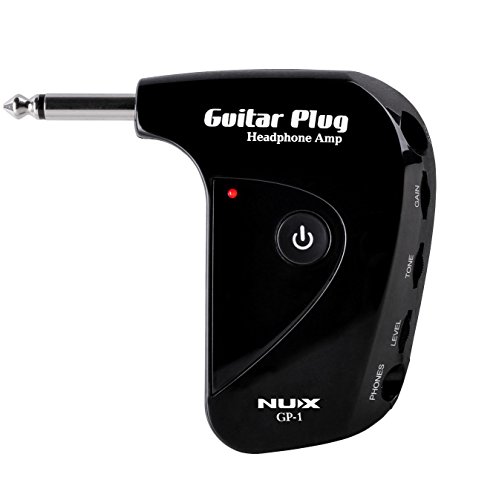
NUX GP-1 remains the no-app option for quiet practice with one basic distorted guitar voice. Gain, tone and volume knobs provide the controls you need, and the auxiliary input lets you feed in backing audio from a wired source. Two AAA batteries keep the setup simple. I would choose it for quick practice when changing presets and editing effects would only be a distraction.
There is no Bluetooth streaming, USB recording or broad amp library. Use wired headphones and do not expect the rechargeable battery or modeling features of the Mighty Plug.
Pros
- A simple battery-powered British distortion sound.
- Power: 2 AAA batteries; Controls: Gain; tone; volume; Inputs: Guitar plug; wired auxiliary input
Cons
- There is no Bluetooth streaming, USB recording or broad amp library.
| Model | GP-1 |
| Power | 2 AAA batteries |
| Controls | Gain; tone; volume |
| Inputs | Guitar plug; wired auxiliary input |

3. BOSS Waza-Air
BOSS Waza-Air is the choice for someone who wants headphones, an instrument transmitter and modeled guitar sound in one system. The included transmitter carries your guitar signal to the headphones, while the gyro-based spatial modes give an alternative to ordinary left-right headphone listening. BOSS Tone Studio provides access to amp and effect editing, and Bluetooth can bring in backing music.
This is the guitar Waza-Air system, not Waza-Air Bass or ordinary Bluetooth headphones. It is a more involved purchase than a plug-in amp, and both headphones and transmitter need charging.
Pros
- An integrated wireless guitar headphone system with spatial sound.
- Drivers: 50 mm; Instrument connection: Included wireless transmitter; Editing: BOSS Tone Studio app
Cons
- This is the guitar Waza-Air system, not Waza-Air Bass or ordinary Bluetooth headphones.
| Model | Waza-Air guitar system |
| Drivers | 50 mm |
| Instrument connection | Included wireless transmitter |
| Editing | BOSS Tone Studio app |

4. VOX amPlug 3 AC30
VOX amPlug 3 AC30 is the simple choice for a player who wants a British combo character without scrolling through a large model library. Its two channels, onboard effects and rhythm patterns make it useful for an uncomplicated practice routine. The folding plug connects directly to the guitar, and an auxiliary connection supports playing along with an external source. This is the AC30 version rather than another amPlug 3 voicing.
It uses AAA batteries and wired headphones. Choose a USB-recording model if recording directly to a computer is a priority, or another amPlug voice if AC30-style tones are not what you want.
Pros
- Classic AC30-style practice with rhythm patterns and two channels.
- Channels: 2; Power: 2 AAA batteries; Headphones: Wired; Practice aids: Effects and rhythm patterns
Cons
- It uses AAA batteries and wired headphones.
| Model | amPlug 3 AC30 |
| Channels | 2 |
| Power | 2 AAA batteries |
| Headphones | Wired |
| Practice aids | Effects and rhythm patterns |

5. NUX Mighty Plug MP-2
NUX Mighty Plug MP-2 is the option for a player who wants to shape guitar and bass tones in the MightyAmp app. Amp modeling, cabinet impulse responses and practice rhythms provide more variety than the GP-1. Bluetooth backing audio and USB audio streaming make it useful at a desk as well as for headphone practice. This is the MP-2 unit, which differs from the MP-3 Pro.
MP-2 uses Micro-USB and has a different feature set from the USB-C Mighty Plug Pro. App editing is part of the workflow, so choose a knob-based model if you want to practice without a phone.
Pros
- An app-edited guitar and bass modeler with USB audio.
- Editing: MightyAmp app; Audio: Bluetooth backing audio; USB audio stream; Power: Rechargeable; Micro-USB
Cons
- MP-2 uses Micro-USB and has a different feature set from the USB-C Mighty Plug Pro.
| Model | MP-2 Mighty Plug |
| Editing | MightyAmp app |
| Audio | Bluetooth backing audio; USB audio stream |
| Power | Rechargeable; Micro-USB |

6. Blackstar amPlug 2 FLY - Guitar
Blackstar amPlug 2 FLY Guitar remains a useful choice for simple practice with clean, crunch and lead voices. Its ISF control changes the tonal character, and the onboard effects give you a little more variety than a single distortion circuit. The small plug-in format is convenient when you already own comfortable wired headphones and want a basic setup.
This is the guitar version, not the bass amPlug. It uses batteries and does not offer the USB recording or detailed app editing of newer rechargeable modelers.
Pros
- A compact three-voice practice amp without app setup.
- Voices: Clean; crunch; lead; Tone control: ISF; Power: AAA batteries
Cons
- This is the guitar version, not the bass amPlug.
| Model | AP2FLYGTR |
| Voices | Clean; crunch; lead |
| Tone control | ISF |
| Power | AAA batteries |

7. Valeton Rushead Max RH-100
Valeton Rushead Max RH-100 suits a guitarist who wants several basic sounds without an app. Clean, overdrive and distortion selections sit alongside modulation and ambience choices, while the auxiliary input supports wired backing audio. USB charging avoids buying disposable batteries. I would choose it for convenient everyday practice rather than detailed recording or preset management.
Check that the listing is the guitar RH-100. Rushead Max Bass is a separate product. It has no Bluetooth audio connection and does not become a computer audio interface just because it charges through USB.
Pros
- A rechargeable plug-in amp with physical effect switches.
- Amp voices: Clean; overdrive; distortion; Backing audio: Wired auxiliary input; Power: USB rechargeable
Cons
- Check that the listing is the guitar RH-100.
| Model | RH-100 guitar version |
| Amp voices | Clean; overdrive; distortion |
| Backing audio | Wired auxiliary input |
| Power | USB rechargeable |
How to know if you need a Headphone Amp?
You need a guitar headphone amp when you want to hear an electric guitar through headphones without another amplifier, interface or modeler providing that signal. Headphone impedance alone does not answer that question. Match headphones to the particular device’s output rather than applying a universal 32- or 50-ohm rule.
Summary
Choose the controls and connections you will use. A basic battery model is convenient for short practice sessions; app editing and USB audio matter more when you want to shape presets or record.
My top pick is the Fender Mustang Micro Plus, an extremely versatile and popular option from a renowned company.
My budget pick is the NUX GP-1, a nifty, inexpensive option with solid battery life for quiet practice sessions.