
A keytar lets you play keyboard parts while standing and moving onstage. Choose a MIDI controller if you already have a sound source, or a synthesizer with onboard sounds if you want a more self-contained instrument.
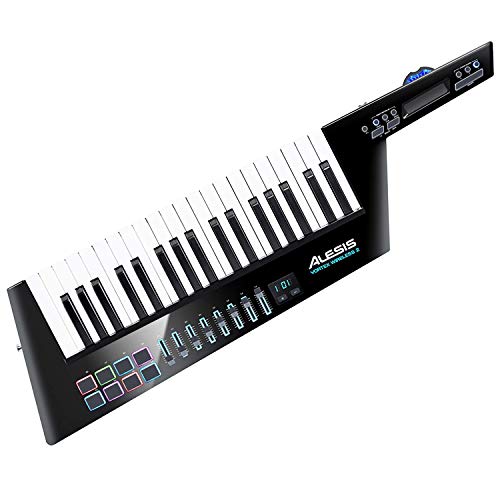
My top pick is the Alesis Vortex Wireless 2. It gives software-instrument players wireless control, aftertouch and plenty of assignable controls.
For onboard sounds, my second recommendation is the Korg RK-100S 2. Its compact keybed and ribbon controllers suit expressive lead playing without a computer.
The 3 Best Keytars (2026)

Let’s compare these in more detail.
1. Alesis Vortex Wireless 2
Pros
- Velocity-sensitive keys with aftertouch
- Eight assignable pads and eight faders
- Wireless USB receiver included
Cons
- Needs a computer or external sound module
The Alesis Vortex Wireless 2 is my top pick for players who already use software instruments or a MIDI sound module. Its 37 velocity-sensitive keys have aftertouch, so you can change a supported sound by pressing into a held note. Eight backlit pads and eight faders give you separate controls for percussion, clips, levels or instrument parameters.
The neck puts pitch, sustain and octave controls under your left hand. You can assign the touch strip and tilt sensor to suit a patch, then disable the sensor when movement should not affect the sound. This is useful for a performer who wants more control than a small keyboard alone provides.
The included USB receiver connects wirelessly to a Mac or PC; this connection is not Bluetooth. USB MIDI and a five-pin MIDI output also support wired setups. Power comes from USB or four AA batteries. The Vortex has no internal sound engine, so include the sound source and its audio connection in your stage setup.
| Type | MIDI controller; no internal sounds |
| Keys | 37; velocity sensitive with aftertouch |
| Connections | Wireless USB receiver, USB MIDI, five-pin MIDI out |
| Power | USB or four AA batteries |

2. Korg RK-100S 2
Pros
- Internal sounds work without a computer
- Two ribbon controllers
- Battery operation and included soft case
Cons
- Slim keys require adjustment from a full-size keyboard
- No built-in speaker
Choose the Korg RK-100S 2 if you want onboard sounds and a compact keybed. Its 200 programs cover lead playing and other keyboard parts, and the wooden body keeps the familiar guitar-like shape. Connect headphones or an amplifier to hear it: unlike some small portable keyboards, it has no built-in speaker.
The 37 slim keys take less room than standard keys. A short ribbon on the neck handles pitch and modulation, while the long ribbon above the keys can shape pitch or filter movement. A microphone input and vocoder add a different way to play vocal effects, and an arpeggiator can turn held notes into patterns.
It runs on six AA batteries or a separately sold AC adapter. Korg includes a strap and soft case, and its computer editor lets you change sound and MIDI settings. MIDI output and USB also let the S2 control external instruments. I would pick it over the Alesis when keeping a computer out of the sound chain matters more than having pads and faders.
| Generation | RK-100S 2 |
| Keys | 37 slim, velocity sensitive |
| Internal programs | 200 |
| Performance controls | Two ribbons; vocoder; arpeggiator |
| Power | Six AA batteries or optional AC adapter |
3. Behringer MS-1 MKII
Pros
- Full-size keys and direct synth controls
- Strap and modulation handgrip included
- Sequencer, arpeggiator and CV connections
Cons
- Monophonic: plays one note at a time
- Requires external power
The Behringer MS-1 MKII suits bass lines and synth leads. It is an analog monophonic synthesizer, so it plays one note at a time. Its 32 full-size keys and panel of faders favor shaping a sound directly, while the sequencer and arpeggiator help build repeating parts.
Attach the supplied strap and modulation handgrip to use it as a keytar. The handgrip adds pitch and modulation control away from the main panel. You will still need external power and an amplifier or headphones, which makes this a more involved mobile setup than a battery-powered synth.
The oscillator offers four mixable waveforms, followed by an analog filter and envelope controls. MIDI, USB MIDI and CV/gate connections make it useful alongside other synths too. Pick it for hands-on analog sound design; the Korg is the better choice for chords, preset variety and a compact battery-powered performance.
| Generation | MS-1 MKII |
| Type | Analog monophonic synthesizer |
| Keys | 32 full-size |
| Performance kit | Strap and modulation handgrip included |
| Power | External adapter |
Are Keytars Easy to Play?
If you already play a keyboard, the notes and fingering will be familiar. Playing with the instrument on a strap changes your hand position, though, and the left hand often controls pitch, modulation and sustain rather than playing bass notes. Practice standing up before taking it to a gig.
Are Keytars Heavy?
Weight varies between models. A MIDI controller has no internal sound engine, but that alone does not tell you how comfortable it will be. Compare the listed weight, body dimensions and strap position. Include batteries and any transmitter you plan to attach, and try the instrument standing up if possible.
What do People Think of Keytars?
A keytar brings the keyboard player to the front of the stage. Its appearance is a matter of taste; its practical appeal is easier movement and access to expression controls while playing a melody. Choose one because that format suits your performance, rather than expecting it to replace every part of a conventional keyboard rig.
What to look for in a Keytar when Buying?
Decide how you will produce sound first. The Vortex sends MIDI to another instrument or computer. The RK-100S 2 has its own digital sounds, while the MS-1 MKII is an analog mono synth for single-note parts. Neither an internal sound engine nor wireless MIDI automatically means wireless audio to the PA.
Next, compare the keybed. Slim keys keep the Korg compact; the Behringer has full-size keys. Aftertouch, ribbons, pads and faders matter only when your chosen sounds respond to them. Check that the neck controls sit comfortably under your hand and that you can reach octave and sustain buttons while playing.
Check power and connections against the whole rig. A battery-powered instrument still needs an audio route to an amplifier, mixer or headphones. USB MIDI, five-pin MIDI and a wireless USB receiver serve different purposes. Budget for a case, cables and any sound source you need, rather than comparing the instrument alone.
Conclusion
My top keytar pick is the Alesis Vortex Wireless 2 for controlling software instruments and MIDI gear. Its pads, faders and aftertouch make it a useful performance controller.
Choose the Korg RK-100S 2 when you want built-in sounds and a smaller body. The MS-1 MKII is the specialist choice for analog bass lines and leads.
Featured Image: By Brandon Daniel from USA / CC BY-SA