
Lightweight bass guitars can appeal to young or beginner bassists, players seeking a more manageable instrument, and traveling musicians. Compare the actual weight, balance and reach of each bass. A lighter instrument may be easier to handle, but it is not a guarantee against discomfort during extended playing.
Fortunately, there are many great lightweight electric bass guitars out there for bassists looking for more comfort and portability.
I would recommend Squier Classic Vibe ’70s Precision Bass Black, a straightforward four-string Precision-style bass; confirm the exact instrument’s weight and balance.
If you are after something more affordable, you can check out my budget pick, Ibanez miKro GSRM20 Black, which provides great tones as well as a comfortable playing experience for its price.
The 7 Best Lightweight Bass Guitars (2026)




Let’s compare these in more detail.

1. Squier Classic Vibe '70s Precision Bass Black
The Squier Classic Vibe '70s Precision Bass combines a traditional P-style layout with 1970s-inspired styling. This recommendation is the black four-string model with a maple fingerboard. A similarly named five-string Jazz Bass is a different instrument, with a different pickup arrangement and neck width. Checking the complete model name avoids an easy mistake when comparing listings.
Pros
- Simple passive volume and tone controls
- Full-scale Precision layout with split-coil pickup
- Maple fingerboard and 1970s-style appointments
Cons
- Full 34-inch scale may require a longer reach
- No maker-guaranteed maximum weight
Its split-coil pickup and passive volume/tone controls make it straightforward to use. You can move from a more open sound to a darker response with the tone control without managing an onboard battery or several EQ bands. That simplicity can be useful for learning how plucking position and articulation affect a part before adding more electronic adjustment.
The current manufacturer's specification lists a nyatoh body and a 34-inch scale. Those details do not establish a guaranteed low weight: wood density and the completed instrument vary. Ask a dealer for the measured weight of the actual bass you would receive, then consider its balance on a strap as well as the number. A familiar full-size body may feel comfortable to one player and cumbersome to another.
| Weight | Varies by individual instrument; ask for measured unit weight |
| Strings | 4 |
| Scale Length | 34 inches |
| Pickups | Fender-designed alnico split single-coil |
| Controls | Master volume, master tone |
It remains my top pick for players wanting a conventional Precision-style instrument with a simple control layout. The maple neck's finish and width deserve a hands-on check if possible. Compare it with the smaller miKro below if reach is your main concern, rather than assuming that a model described as lightweight will automatically suit a child or prevent fatigue. The embedded Classic Vibe demonstration shows the Walnut finish; the purchase recommendation here is the black maple-fingerboard version.
2. Ibanez miKro GSRM20 Black
The Ibanez miKro GSRM20 is a compact alternative for players who find a full-scale bass awkward to reach across. Its 28.6-inch scale is shorter than both the 34-inch instruments here and the 30-inch Bronco. That difference changes fret spacing and the feel of the strings, so it is useful to compare the actual playing position rather than choosing from the body photograph alone.
Pros
- Shorter scale reduces fret-to-fret reach
- Separate P/J pickup volumes
- No active-EQ battery requirement
Cons
- Short-scale feel differs from a full 34-inch bass
- Actual weight and setup still vary
The passive Dynamix P and J pickups have separate volume controls and a shared tone control. Try the neck pickup alone, the bridge alone and then a blend to hear how each position fits a part. This supplies more pickup-mixing options than a single-pickup bass without introducing an active preamp or several bands of onboard EQ.
Ibanez's current US specification identifies a poplar body, maple neck and jatoba fingerboard for this model. Poplar is not proof of poor tone or a lack of professional usefulness. Setup, strings, amplification and the player's articulation matter, while regional versions can have different specifications. Check the exact black model's listing instead of copying details from a different finish or territory.
| Weight | Ask for the exact instrument's measured weight |
| Strings | 4 |
| Scale Length | 28.6 inches |
| Pickups | Dynamix P neck, Dynamix J bridge |
| Controls | Neck volume, bridge volume, master tone |
It remains a useful budget-oriented choice for a smaller playing footprint or a compact backup instrument. A shorter scale is not a mandatory beginner stage that every player must outgrow. Check string spacing, seated balance and standing reach, and arrange a setup appropriate to the player. Request the actual unit's weight if weight is the deciding factor; compact dimensions alone do not certify an exact mass.
3. Fender Player II Precision Bass Black Maple
The Fender Player II Precision Bass offers a familiar full-size Precision layout with a modern C-shaped neck and rolled fingerboard edges. The exact version here is black with a maple fingerboard. It is a useful choice for players prioritising a conventional passive bass and a comfortable neck feel, while retaining the 34-inch playing range of the earlier Player series.
Pros
- Rolled fingerboard edges and modern C neck
- Simple passive split-coil layout
- Separate adjustable bridge saddles
Cons
- Full-scale reach and body dimensions
- No guaranteed weight reduction over original Player
An Alnico 5 split single-coil pickup, master volume and tone controls supply the basic signal path. There is no active onboard EQ to manage. Adjusting the tone control and playing closer to the neck or bridge can produce practical variations without adding several pickup combinations. The four-saddle bridge supports individual string setup and intonation adjustment.
The current model uses an alder body, but neither alder nor the Player II name guarantees a particular weight. The rolled edges are a comfort feature, not evidence that the entire bass is lighter than an earlier Player. Ask for a measured instrument and compare how it balances with the strap height you use. Neck reach and body position can matter as much as mass.
| Weight | Unit-specific, not a fixed model-wide value |
| Strings | 4 |
| Scale Length | 34 inches |
| Pickups | Player Series Alnico 5 split single-coil |
| Controls | Master volume, master tone |
Choose it if the full-scale Precision format already suits you and the neck details justify the step beyond simpler options. Try the maple fingerboard and neck finish rather than treating brand reputation as a universal fit guarantee. The embedded video shows the earlier Player Precision, so its broad layout is background; use the current Player II specifications for the recommended version.

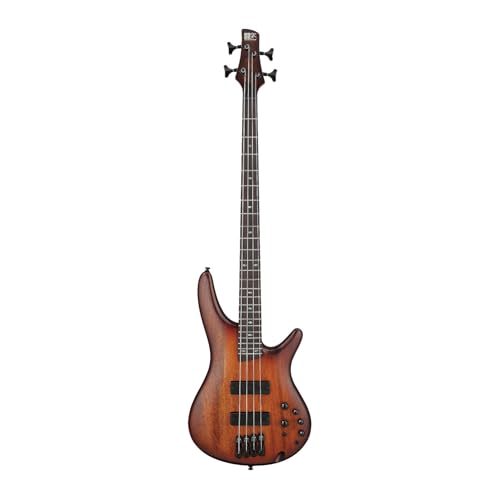
4. Ibanez SR500A Mahogany Brown Burst Low Gloss
The Ibanez SR500A offers a contoured full-scale bass with more tone-shaping options than the passive Precision models. The current Mahogany Brown Burst Low Gloss version uses an okoume body, rosewood fingerboard and a five-piece roasted maple/walnut neck. Mahogany in the colour name does not mean the body itself is made from mahogany.
Pros
- Slim SR neck with roasted maple/walnut construction
- MR5S saddles adjust string spacing
- EQ bypass and selectable mid frequencies
Cons
- More controls and active-EQ power management
- Slim body does not guarantee a fixed weight
Two Bartolini BH2 pickups feed a balance control and three-band EQ. The mid-frequency switch changes the area affected by the mid adjustment, while EQ bypass makes the treble control function as a passive tone control. Start with the EQ centred and establish a useful pickup balance before boosting several bands; otherwise a louder setting can disguise an unsuitable sound in the arrangement.
The MR5S bridge permits string-spacing adjustment at the saddles. That can be useful when fine-tuning the right-hand feel, although it should be approached as part of a complete setup with alignment and intonation checked. Its slim SR profile and contoured body are useful ergonomic features, but only the weight and balance of the actual instrument settle whether it feels light to you.
| Weight | Confirm measured weight of the exact stock instrument |
| Strings | 4 |
| Scale Length | 34 inches |
| Pickups | Two Bartolini BH2 humbuckers |
| Controls | Volume, balance, three-band EQ, EQ bypass, mid-frequency switch |
This is a good choice for a player who wants a full-scale bass with several usable sounds from its onboard controls. Account for the prescribed active-electronics battery arrangement and learn what each switch does before using it on stage. The embedded SR500E video is previous-model background: the SR500A has a revised neck and bridge, so it should not be treated as an identical instrument with a different label.
5. Sterling by Music Man StingRay RAY4 Black Maple
The Sterling by Music Man StingRay RAY4 provides a different pickup and control approach from the Precision-style instruments. The exact solid-black version here has a maple fingerboard and a basswood body in the current manufacturer's specification. Trans Black Satin and dual-pickup RAY4HH versions are distinct variants and should not be merged into one set of specifications.
Pros
- Straightforward single-humbucker pickup layout
- Independent bass/treble adjustment
- Narrower nut than some Precision-style models
Cons
- Active preamp requires battery management
- 34-inch scale rather than short scale
Its single ceramic humbucker works with a two-band active preamp. Volume, bass and treble controls let you adjust the output and frequency balance without a pickup-blend knob. Begin with the EQ neutral and use the amplifier settings you normally play through, then make small changes to fit the part. A broad boost is not automatically a more useful bass sound.
| Weight | Ask dealer for measured unit weight and balance |
| Strings | 4 |
| Scale Length | 34 inches |
| Pickups | One ceramic humbucker |
| Controls | Volume, bass, treble |
The scale is 34 inches, so this is a full-scale instrument despite its relatively narrow nut and compact-looking body. It may suit someone who likes that neck profile, but it is not a short-scale alternative to the miKro or Bronco. Request the actual unit's weight and try the strap balance; a body-wood label does not guarantee that every RAY4 will meet a particular weight target.
Choose it for the single-humbucker layout and simple active EQ when those features fit your playing. Plan for a working 9V battery and check the control diagram. A new instrument may need a setup for your preferred strings and action, but do not assume every unit arrives with a fault. Compare the whole instrument's feel rather than judging only a photograph or a fixed shipping-weight figure.

6. Yamaha TRBX174 Red Metallic
The Yamaha TRBX174 Red Metallic offers a straightforward passive P/J arrangement in a full-scale bass. Its current manufacturer's specification identifies a mahogany body and maple neck, with a rosewood fingerboard. Those construction details are useful for identifying the exact model, but they do not justify a guaranteed weight or a claim that one wood automatically gives better tone.
Pros
- Separate pickup volumes with shared tone control
- Passive electronics need no active preamp battery
- 24 frets and conventional 34-inch scale
Cons
- Full-scale reach may be excessive for some players
- No manufacturer-guaranteed low weight
Separate volume controls for the neck and bridge pickups, together with a shared tone control, let a learner explore several balances without an onboard active preamp. Start with one pickup at a time before combining them. This makes the effect of pickup position easier to recognise and can help when deciding which sound sits behind a vocal or supports a denser band part.
The 34-inch scale and 24 frets provide a conventional full-size playing layout. Check the reach to the first fret and the seated body position, especially for a smaller player. A packaged shipping figure includes materials beyond the instrument and should not be presented as the bass's exact weight. Ask for the measured stock unit and compare it with your own comfort requirement.
| Weight | Unit-specific; do not substitute packaged shipping weight |
| Strings | 4 |
| Scale Length | 34 inches |
| Pickups | Split single-coil neck, single-coil bridge |
| Controls | Neck volume, bridge volume, tone |
It remains a practical entry option for someone wanting a passive full-scale bass with pickup-mixing flexibility. Setup, string choice and amplification matter more than an unsupported claim that its pickups cannot sound professional. Compare it with a short-scale model if reach is the main obstacle, and judge balance as well as mass before choosing it for long rehearsals.
7. Squier Sonic Bronco Bass Black Laurel
The Squier Sonic Bronco Bass is a simple short-scale choice for players who want fewer controls and a shorter reach. The exact black model here has a laurel fingerboard and a 30-inch scale. That lies between the smaller miKro and the 34-inch instruments in this guide, offering a useful comparison for someone deciding how compact a bass needs to be.
Pros
- 30-inch scale offers shorter reach
- Simple single-pickup passive controls
- Four individually adjustable bridge saddles
Cons
- Fewer pickup-combination options
- Actual weight and neck balance vary
One single-coil pickup, a volume control and a tone control keep the signal path straightforward. You do not get separate neck/bridge pickup balances or an active preamp. This can be useful when concentrating on fretting, rhythm and articulation, although someone wanting several pickup voices may prefer the miKro's P/J layout.
The current Sonic version has a four-saddle hardtail bridge and sealed-gear tuners. Individual saddle adjustment helps with setup and intonation. The manufacturer describes a thin lightweight poplar body, but there is no single guaranteed mass for every example. Ask for the actual instrument's weight and check whether the neck stays comfortably positioned when you relax the fretting hand.
| Weight | Request actual unit weight; no fixed mass guaranteed |
| Strings | 4 |
| Scale Length | 30 inches |
| Pickups | One Squier single-coil |
| Controls | Volume, tone |
Choose it for a compact passive layout, rather than assuming a short scale is only suitable for children. Adults may also prefer the reach and string feel. Fit depends on body size, neck shape, strap position and setup together. The embedded video demonstrates an older Bronco version, so use it as background for the simple concept; the current Sonic's hardware and exact variant are described here.
What is a lightweight bass guitar?
There is no universal weight boundary that makes a bass lightweight. Decide what you can comfortably handle, then ask for the measured weight of the exact instrument. Body shape, neck balance, strap position and playing duration also matter. A model name or shipping weight does not establish that every example will meet your target.
Designers can reduce mass through body dimensions, chambering, hardware and material choices. Those choices differ between models; a lighter bass does not necessarily use aluminium in place of all brass or steel parts. Lightweight tuners can also change neck balance. Compare the completed instrument rather than assuming a single component explains its weight.
Wood density varies within species, so alder, mahogany, poplar or okoume does not by itself guarantee a lighter or heavier finished instrument. Some chambered or hollow-body designs reduce body mass, although their size and balance still need checking. Request an actual measurement and compare like-for-like instruments, excluding packaging and accessories.
Are lightweight bass guitars better for kids?
A smaller or lighter bass can be easier for some children to position, but fit is individual. Check seated support, reach to the first fret, neck width and how the instrument sits on a strap. Short scale reduces fret spacing, while body size and weight are separate features. A teacher can help compare a compact model with a full-scale instrument.
What is the difference between a lightweight and a normal bass?
Lightweight describes a practical preference rather than a separate technical category. A full-scale instrument can be relatively light, and a short-scale bass can still feel neck-heavy. Compare actual mass, dimensions, balance and carrying arrangements. Those differences are more useful than dividing every model into two unsupported weight ranges.
What to look out for when buying a lightweight bass guitar?
Consider measured weight, scale length, balance, sound and playability together. Set a personal weight target rather than treating one value as ideal for everyone. Try both seated and standing positions where possible, and make sure the actual stock unit is the one whose weight has been quoted. A suitable return arrangement helps when buying remotely.
For a younger player, compare short scale and full scale with attention to comfortable reach and posture. Short scale is a valid long-term choice for adults as well as children, not a mandatory temporary stage. A good setup and appropriate strings can be as useful as changing the instrument size.
For a touring or backup bass, consider the case, total carrying load, neck stability, electronics and access to replacement strings as well as instrument weight. Choose the scale that suits your playing. A wider strap or different playing position can change comfort, but no particular bass weight promises to prevent shoulder or back pain.
Should you invest too much in a lightweight bass?
A manageable weight can matter to a beginner or an experienced professional. Set the budget around the features and fit you need, including a setup, strap, case and amplification. A straightforward passive instrument may be entirely suitable for years of use; experience alone does not require a more expensive or more elaborate bass.
If a bass meets a strict weight or balance requirement, paying for a carefully selected instrument may be worthwhile. Still compare its sound and setup with alternatives, and request the exact measurement. Price is not a reliable substitute for checking comfort, performance or the particular unit you will receive.
Conclusion
A lighter, well-balanced bass can be a useful choice for players seeking easier handling and transport. Match weight with reach, neck shape and setup rather than relying on a wood name or a universal weight target. The right fit is individual, and no instrument guarantees discomfort-free extended playing.
A heavy bass does not mean better or worse, as the same goes for lighter bass guitars. There are many great options in the market, just as the Squier Classic Vibe ’70s Precision Bass Black, which offers a traditional Precision-style layout and vintage appearance. Check the exact unit’s weight and balance before deciding whether it suits you.
You can also check the Ibanez miKro GSRM20 Black, a compact bass with a 28.6-inch scale. Its shorter fret spacing may help some smaller players reach comfortably, but check seated support, neck width and the exact instrument’s weight and balance.