
Pedalboard power supplies take a mains or adapter input and provide power connections for multiple pedals. Various options fit different budgets and electrical requirements. This guide will help you find the right one.
Building a pedalboard often reveals the challenge of finding a power source for all the pedals. I’ll present the best 7 pedalboard power supplies available today.
My top recommended pedalboard power supply is the Truetone 1 SPOT PRO CS12. This popular 12-outlet power supply suits professionals and large pedalboards.
My second recommended pedalboard power supply is the Donner DP-1. This affordable power supply offers 10 outlets at a very modest price.
Explore my guide on setting up a guitar pedalboard.
The 7 Best Pedalboard Power Supplies (2026)




Let’s compare these in more detail.

1. Truetone 1 SPOT PRO CS12
Starting this list is the Truetone 1 SPOT PRO CS12, a large power supply with 12 isolated outlets. Its mixture of fixed, switchable and variable outputs gives you options for pedals with different requirements. It is particularly relevant when a board contains a few unusual power connections alongside ordinary 9 V DC pedals.
The 12 outputs comprise two 18 V DC outlets, four switchable 9/12 V DC outlets, one variable 4–9 V DC outlet, four fixed 9 V DC outlets and one 9 V AC outlet. The AC socket is for compatible AC-powered pedals, not another ordinary DC connection. Check the printed voltage, current and polarity for the exact output you use.
The casing is substantial, so check the dimensions, connector clearance and mounting arrangement before buying. Included pedalboard brackets are useful only when they fit your board. Keep the supply secure without blocking ventilation or placing cable connectors where they will be crushed during transport.
The CS12 remains useful for a mixed-requirement board. Compare the newer CS11 if you want more available 9 V DC power and expansion rather than a dedicated AC outlet. Count the compatible sockets you actually need: a 12-output label does not mean all twelve can power the same type of pedal.
2. Donner DP-1
The Donner DP-1 is a budget power supply for a modest pedalboard. Its ten outlets and compact aluminium housing can reduce the number of separate adapters you carry. The useful question is whether those specific outputs match your pedals, rather than whether ten sockets must be better than a smaller supply.
Donner specifies seven 9 V outputs at 100 mA, one 9 V output at 500 mA, a 12 V output at 100 mA and an 18 V output at 100 mA. Reserve the higher-current 9 V socket for a compatible pedal that needs it. Do not connect a 9 V-only pedal to the 12 V or 18 V socket.
The DP-1 provides individual short-circuit protection and indicator lights. That protection should not be confused with a guarantee of galvanic isolation or the elimination of ground-loop noise. For a board with demanding digital pedals or an existing power-related hum problem, compare a supply with clearly specified electrically isolated outputs.
It is worth considering for a small setup whose requirements fit the rated sockets. Its external adapter and fixed-voltage layout are less flexible than the larger isolated supplies here. The MXR Mini Iso-Brick is another compact option when isolated outputs matter more than having ten connections.

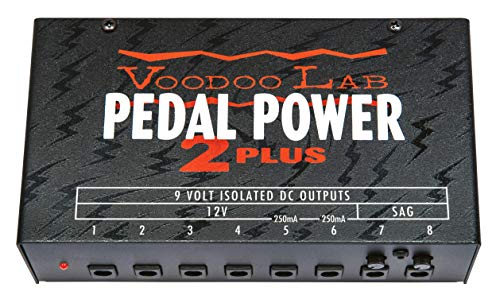
3. Voodoo Lab Pedal Power 2 Plus
Voodoo Lab offers several power supplies in its Pedal Power series. The Pedal Power 2 Plus remains useful for a board built around lower-current pedals, with eight electrically isolated outputs. The newer Pedal Power 3 family deserves comparison when several modern digital pedals need more current.
All eight outputs provide 9 V DC in their normal settings. The first four are rated at 100 mA, outputs five and six at 250 mA, and outputs seven and eight at 100 mA with adjustable SAG. The switched modes have particular voltage and current limits, so read the manual rather than treating every switch as the same 12 V setting.
SAG reduces the voltage on its two compatible outputs to imitate a weakening battery for suitable effects. It is not a general setting for digital processors. Optional current- and voltage-doubling cables perform different jobs, and should be used only with the output combination and pedal requirements the maker specifies.
Its isolated outputs can reduce power-related ground loops, but cannot remove every source of noise in a rig. Confirm the mains-voltage version printed on the delivered unit, especially when travelling or buying across regions. Choose it when its particular outputs and SAG feature fit your board, rather than assuming every eight-pedal setup needs the same supply.

4. MXR M237 DC Brick
The MXR M237 DC Brick provides eight 9 V and two 18 V outputs in a compact housing. It is a straightforward distribution option for pedals that can share a supply. This is the DC Brick, not the separately named MXR Iso-Brick, and its outputs should not be described as electrically isolated.
The manual permits simultaneous use of all outputs within its shared 2,000 mA total current capacity. Individual 9 V outputs have fault indicators to help locate a short. Add up the demands of connected pedals and check their voltage and polarity, rather than assuming each socket independently supplies the entire total.
The standard package includes its required 18 V regulated adapter and pedal power cables. Some retailer listings add instrument or patch cables, so compare the exact package if those extras matter. The selected standalone M237 avoids treating a bundle description as the specification of the power supply itself.
Choose it for a compatible shared-power board with both 9 V and 18 V pedals. If you need isolation between pedals, compare the Mini Iso-Brick or Iso-Brick instead. A power supply is not an audio effect, so the better match is the one that reliably meets your electrical requirements, not one claimed to improve sound regardless of the rig.
5. Eventide PowerMAX V2
Some digital pedals require considerably more current than a basic 100 mA outlet supplies. The Eventide PowerMAX V2 addresses that kind of board with seven isolated main outputs. Its low-profile enclosure and expansion connection are useful when fitting a substantial power system under a pedalboard.
Three outlets are fixed at 9 V DC, and four are selectable between 9, 12, 15 and 18 V. The selectable outputs provide up to 660 mA at 9 V, 500 mA at 12 V, 400 mA at 15 V or 330 mA at 18 V. Changing voltage does not preserve the same available current.
The V2 includes a 24 V auxiliary connection for a compatible expansion unit, plus a 5 V USB charging outlet rated at up to 1 A. That USB port is for charging, not an audio interface. Its included Flex cables have different connectors and polarities, so choose the cable for the pedal rather than merely matching its colour to another lead.
PowerMAX V2 suits a board needing several high-current outputs with mixed voltages. Compare the current CIOKS DC7 V2 if you want seven individually selectable main channels, since PowerMAX has three fixed channels. Check the actual pedal list, cable requirements and space before paying for expansion capacity you may never use.

6. Strymon Zuma
Strymon is known for its effects pedals and power supplies. The Zuma offers nine isolated outputs, each capable of 500 mA at 9 V DC. That makes it relevant to a board containing several digital pedals, although every device still needs matching voltage, current capacity, connector and polarity.
Seven outputs are fixed at 9 V, while two can be selected to 9, 12 or 18 V. On those selectable outputs, available current is 500 mA at 9 V, 375 mA at 12 V or 250 mA at 18 V. A higher voltage is not a general upgrade for a 9 V-only pedal and can damage it.
Zuma uses individual output isolation and additional regulation, rather than merely providing two isolated sockets. Its 24 V expansion connection can power compatible Ojai-family units. Check underside height and connector access, and compare Zuma R300 or Ojai when a smaller board needs fewer outlets.
Its automatic worldwide mains compatibility is useful for travel with the appropriate IEC power lead. Choose it when multiple high-current DC outputs are the priority. The CS12 is more relevant if a specific pedal requires its separate 9 V AC socket, which Zuma does not provide.

7. T-Rex Fuel Tank Junior
The T-Rex Fuel Tank Junior is a compact power supply for a small lower-current pedalboard. Its five electrically isolated outputs each deliver 9 V DC at up to 120 mA. That can suit several analogue effects, but is not enough for every contemporary digital pedal.
All five sockets are 9 V: there are no dedicated 12 V or 18 V pedal outputs. The 115/230 V selector changes the mains input setting, not the voltage delivered to a pedal. Set it correctly before connecting mains power and use an appropriate power lead for the location.
The compact housing helps where underside space is limited. A compatible daisy-chain cable can connect several pedals to one output only when their combined demand fits its 120 mA limit, and those pedals then share that output. Do not assume adding cable plugs adds more available power or maintains isolation between every pedal.
Choose Fuel Tank Junior when five modest 9 V DC loads cover your board. Compare a higher-current supply if a delay, reverb or processor exceeds 120 mA. The larger T-Rex Fuel Tank models offer different output arrangements, so their name alone does not establish compatibility with your particular pedals.
What to look for in a pedalboard power supply when buying?
Buying a power supply can be overwhelming due to the flood of unfamiliar information. To assist you in picking the right one, I’ve highlighted a few key considerations.
Outlet power strength
Different pedals, like reverb, delay and fuzz, need specified voltage, current capacity and polarity. Mains sockets supply AC, while most pedal-power outputs provide DC. Some pedals require AC instead, so never assume an AC socket and a DC socket with the same voltage are interchangeable.
Check each pedal’s manual or power label before buying. The supply must provide the required voltage and polarity, with at least the required current capacity. A compatible pedal draws the current it needs; extra available current is not the same as applying extra voltage.
Isolated outputs
Electrically isolated outputs separate their power circuits and can reduce power-related ground loops between pedals. Individual short-circuit protection is a different feature. Neither isolation nor protection guarantees that a rig will be free of noise from pickups, audio cables, gain settings or other causes.
For more detailed info, check out PMTVUK’s YouTube video explaining everything you need to know about pedal power supply, including power requirements, adapters, polarity, daisy chain, and more.
Where to position power supply on the pedalboard?
The signal chain often comes up when discussing pedalboards. A power supply needs secure positioning with enough clearance for ventilation, connectors and cable routing. Its physical position does not itself increase the audio headroom of your pedals.
A pedalboard is typically personalized for each musician. An underside mount can save playing space if the board has suitable clearance and a compatible bracket. Use secure mounting hardware or the manufacturer’s recommended attachment rather than relying on an improvised position that can loosen in transport.
Route power and audio leads neatly without straining connectors. Keep enough access to change cables and voltage switches deliberately, and check that the mounted supply does not touch the floor or stop the pedalboard fitting its case.
What about the battery-powered route?
Many pedals can run on batteries, while others require an external supply. Battery life depends on the pedal’s current consumption, not simply whether the effect is analogue or digital. Follow the maker’s battery instructions and account for replacement or recharge costs.
A battery is not a general backup that prevents damage from a power-supply fault. Some pedals disconnect their battery when an adapter is inserted. Follow the specific manual instead of assuming simultaneous battery and adapter use gives a stronger signal or automatic failover.
Conclusion
Hope this helped you choose your power supply. There are many options, so pick one that fits your needs carefully.
My top pedalboard power supply pick is the Truetone 1 SPOT PRO CS12, a popular 12-outlet power supply that’s perfect for professionals and mid-to-large pedalboards.
My budget pedalboard power supply pick is the Donner DP-1, a compact ten-output option for pedals whose requirements fit its rated sockets.