
Choosing a keyboard stand with the right height and angle can make playing more comfortable. This matters especially if you stand while performing or use multiple keyboards, where the support range and layout need to suit each instrument.
The Best Piano Keyboard Stands For Standing




Now on to the full list.
There is no single standing keyboard height that suits every adult. Measure your preferred key height, subtract the distance from the keyboard’s base to its keys, and compare the resulting platform height with these adjustable stands:

The Roland KS-11Z is a flexible keyboard stand with separate height and width adjustment. Its steel Z frame leaves space for pedals underneath, and the padded support arms fold down for transport. It is a current alternative to the older KS-18Z listed here previously.
Width adjusts continuously from 566 to 940 mm, while height has seven positions between 645 and 917 mm. The quick-release width lever helps you position the supports beneath your instrument rather than accepting a fixed width. Adjustable rubber feet are useful when the floor is uneven.
The 100 kg load rating makes this a practical option for heavier stage pianos. Still, a high weight rating does not guarantee that an instrument's feet will land safely on the support arms. Follow the keyboard manufacturer's stand guidance and check its underside before buying.
Its main limitation for standing use is reach: a maximum platform height of 917 mm may be too low for some players, depending on the keyboard's own depth. Measure the desired key height first. Choose a taller table or column option below if this range does not suit you.

The On-Stage KS7150 is a fully adjustable platform stand for large keyboards, heavy vintage electric pianos and DJ gear. Its open four-leg layout provides space beneath the instrument. The optional KSA7500 second-tier attachment is separate, so the standard package supports one keyboard.
The telescopic platform adjusts from 29 to 43.5 inches wide, and the height range is 26 to 43 inches. That upper limit gives it more standing-height flexibility than the lower Z stands in this list. Allow for the distance from the keyboard's underside to the keys when measuring your setup.
Its welded and bolted construction is rated for 230 lb. Support bars and hinges reinforce the legs, which fold under the platform for transport. The tradeoff is the broad footprint: measure the stage and pedal space before choosing it for a tight performance area.
The Stellar Labs 555-13830 is a Z-style stand with separate height and width adjustments. Its square-tube frame leaves useful room for pedals, and cushioning on the contact points helps protect the instrument. It remains a straightforward choice when you want this layout without a multi-tier system.
The distributor lists height adjustment from 23 to 35.25 inches and width from 24.5 to 40 inches. This is a relatively low maximum for standing play, so measure carefully if you are tall or use a keyboard with a shallow case. Key count alone does not establish compatibility.
The broad frame can suit a stationary practice setup, but it is less compact to carry than a simple folding X stand. Check the current instructions and load rating for the exact unit before mounting a heavy instrument. Do not assume every Z stand has the same capacity.

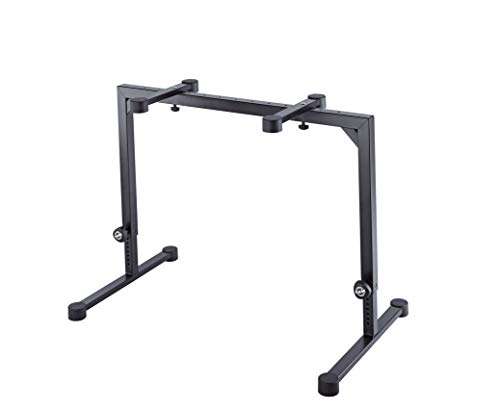
The K&M 18810 Omega Black is a steel table-style stand with an open area underneath for seated legs or pedals. Spring-loaded locking screws adjust its height from 600 to 1,020 mm. That range makes it suitable for seated and standing setups when the instrument's size and your preferred key height match.
Its support arms adjust from 180 to 790 mm apart, with a 345 mm support depth. The published load capacity is 80 kg. Check where the rubber feet of your keyboard sit, rather than assuming every 25- or 88-key instrument will fit because of its note count.
Levelling end caps help on uneven floors, and an engraved scale makes repeated height settings easier. The current manufacturer page lists four cable clamps. Optional 18811 and 18822 stackers add further levels; they are not included with the base stand. It folds flat, but the steel frame is still a substantial item to carry.

The Ultimate Support APEX AX-48 Pro Plus combines a two-tier column stand with a microphone boom and carry bag. The stand's slim central column provides a different layout from the table and Z options above. Check the package name carefully, because a base AX-48 Pro offer does not necessarily include the Plus accessories.
The stand uses 13-inch and 18-inch support arms that store inside the column. Its tiers can be positioned for your playing reach, and the built-in handle helps with transport. Plan pedal placement around the legs and column, especially if you use several pedals side by side.
The column is 46 inches tall; that figure is not a guarantee that a keyboard can be mounted at the very top. Published capacity is 125 lb per tier, with 250 lb total for the stand. Account separately for the weight and footprint of each keyboard, and check that upper-tier instruments do not obstruct the lower keys or controls.

The On-Stage KS7365EJ Pro can hold two keyboards in a compact Z-frame arrangement. The frame folds for transport, while separate height and width adjustments let you position the lower instrument and upper tier to suit the setup. It is useful when two separate stands would occupy too much stage space.
The main tier adjusts from 23.5 to 36.5 inches high. The second tier sits 7 to 12 inches above it and offers angle adjustment in 10-degree increments. Check access to the lower keyboard's display and controls as well as the height of the keys.
The manufacturer's total weight capacity is 400 lb, but the second tier is limited to 60 lb. These are different limits, not a promise of 60 lb on each tier. Place the heavier suitable instrument below and verify that both keyboards are securely supported.
For standing use, the lower tier's maximum height can be restrictive. Measure your preferred position before buying; the upper tier being higher does not solve an uncomfortable lower keyboard. The welded frame provides support, but its collapsed size is less convenient than a single folding X stand.

The On-Stage KS7903 offers three keyboard tiers in an A-frame layout. The support bars adjust across the frame, and each tier's height and angle can be set for access. It suits a multi-keyboard rig when the instruments fit within its support width and weight limits.
The manufacturer's specification sheet lists a 51-inch internal width and 40 lb capacity per tier, with 120 lb total. It describes accommodation for keyboards up to 76 keys; check the actual instrument dimensions because key count and case width are not interchangeable.
Its hinged frame folds for storage, but a three-tier rig still needs careful planning. Measure the complete floor footprint and leave clearance for cables, pedals and controls. Secure each support and centre the instruments according to the instructions before playing. This is a space-saving arrangement, not an automatic choice for three heavy 88-key pianos.
The Ideal Height for Piano Keyboards
A useful starting point is a key height that lets your shoulders stay relaxed and your forearms sit comfortably near level. Adjust from there for your body, instrument and playing style. Stand specifications describe platform height, so remember to account for the keyboard case above it.
Keep enough distance from the keyboard to move across its range without leaning awkwardly or reaching around another tier. Try the position with your usual pedals before committing to it. A stand is an equipment support, and cannot guarantee that a particular posture will prevent injury.
Factors to Consider When Choosing the Ideal Keyboard Stand
The best height for your keyboard piano ensures you feel most comfortable while playing. To reach this height, you need a good stand. Keyboard stands come in many types. Here are some key factors to help you choose the right one:
Durability and Strength
You should choose a stand that can sturdily support your keyboards. Heavier keyboards need more stable stands. Forget about the price! If it can offer stronger support for your keyboard, go for it.
The weight of your keyboard should influence your choice of a stand. If money isn’t tight, opt for a sturdier stand. Don’t risk your keyboards by saving on a cheaper stand.
Check the stand’s load specifications before buying. Add the weight of every supported instrument and accessory, then observe the separate limit for each tier as well as the total. Do not lean your body weight on the keyboard or treat the stand as a support for your arms.
Check for the Center of Gravity
Every piece of equipment, like a keyboard stand, has a center of gravity. If you’re using multiple keyboards, you need to determine this center. If you don’t, the stand might topple when you place both keyboards on it.
Be careful when placing keyboards on a multi-tiered stand. Ensure the keyboard on the higher tier is balanced. If it’s off-center, the stand might tip over, which could lead to damage or regret.
Dimensions and Weight
Dimensions matter for both stand size and your own height. A lower stand will cramp your legs if you’re taller, making you slouch while playing the piano. Keep your comfort and posture in mind.
Match the support width and depth to the instrument’s underside and the manufacturer’s placement instructions. A fixed difference between stand width and keyboard width will not suit every case. Check the load limit separately for the second and third tiers.
- Dimensions impact usability
- Stand height for comfort
- Check weight rating
Keyboards You Will Be Using
A single keyboard needs just a simple stand. If you’re using several keyboards, choose a multi-tiered stand or set up several stands in an “L” shape. Some keyboardists prefer stacking keyboards, while others want each on a separate stand.
Your Regular Venue for Your Gigs
Consider the venue where you often perform. If you play in a small gig house with tight stage space, think about the size of the stand you buy. Don’t bring a four-legged stand into a cramped space. Choose something with a small footprint.
Portability
You should think about the portability of the stand. For multiple gigs in a day, a portable one is better. Though a four-legged stand is sturdier, you need something quick to set up and pull down. Additionally, pick one that’s easy to move between venues.
Most Recommended Standing Position Piano Keyboard Stands
Conclusion
Looking at the list of keyboard stands and key factors helps you quickly choose the right stand for your piano. If you’re handy and enjoy DIY projects, you can also build a custom piano stand. This approach is often the most fulfilling and practical, as it’s made specifically for your needs.