
A power conditioner improves the quality of the electricity supply going into your music gear. It can help to reduce electrical noise through filtering and surge protection; models with automatic voltage regulation can also correct specified voltage fluctuations, and it can also protect your gear against electrical surges.
When buying a power conditioner for your musical setup, keep in mind that their sole purpose is to provide your equipment with efficient and proper power. Surges and fluctuations are a normal part of local power flow. However, their disadvantage is that the power fluctuations create noise interference and affect the sound quality coming from your instruments.
A power conditioner offers protection from this interruption and creates a safe space between your music system and the outlet.
My top recommended power conditioner is the Furman M-8×2 8 Outlet Power Conditioner, a very efficient, compact, and overall great-quality power conditioner.
My second recommended power conditioner is the PDU Power Strip Surge Protector. This is an affordable power conditioner that can get the job done on a tighter budget.
The 5 Best Power Conditioners (2026)
Let’s compare these in more detail.

1. Furman PL-8C 120V
Furman PL-8C is the rack choice for a studio or live rig that needs protected power distribution and useful lighting. The 120V model has nine outlets, a 15A rating, Series Multi-Stage Protection, Linear Filtering Technology and Extreme Voltage Shutdown. Its pull-out lights help you see equipment in a dark rack.
This is not an automatic voltage regulator or battery backup. Check the total load and use the correct regional voltage version; the selected 120V unit is not a 230V EU model.
Pros
- Top Pick – Rack protection, filtering and pull-out lights.
- 120V
Cons
- This is not an automatic voltage regulator or battery backup. Check the total load and use the correct regional voltage version; the selected 120V unit is not a 230V EU model.
| Selected voltage | 120V |
| Rating | 15A |
| Outlets | Nine |
| Format | Rackmount |

2. Furman PST-6 120V
PST-6 suits a small recording desk that does not need rack mounting. It gives you six outlets in a compact strip, with spike/surge protection and RFI/EMI filtering. It is a simpler choice than the more advanced PST-8 when you mainly need an organized power connection for a modest setup.
It does not offer the same protection features as the PST-8 and does not regulate voltage or keep equipment running in a power cut. Match the 120V version to your supply.
Pros
- Budget Pick – A six-outlet desktop power strip with filtering.
- 120V
Cons
- It does not offer the same protection features as the PST-8 and does not regulate voltage or keep equipment running in a power cut. Match the 120V version to your supply.
| Selected voltage | 120V |
| Rating | 15A |
| Outlets | Six |
| Format | Desktop strip |

3. Eaton Tripp Lite LC1200
LC1200 is the choice here for automatic voltage regulation, rather than simply surge protection and outlet distribution. The 120V four-outlet unit corrects specified low and high input-voltage conditions and provides surge protection and line-noise filtering. It is a different type of product from the Furman strips and rack conditioners.
It is not a UPS and provides no battery runtime. Confirm the attached equipment’s load and the exact voltage specifications; this guide’s offer is the LC1200 model.
Pros
- A four-outlet line conditioner with automatic voltage regulation.
- LC1200
Cons
- It is not a UPS and provides no battery runtime. Confirm the attached equipment’s load and the exact voltage specifications; this guide’s offer is the LC1200 model.
| Model | LC1200 |
| Selected voltage | 120V |
| Outlets | Four |
| Function | Automatic voltage regulation |

4. Furman PST-8 120V
PST-8 is the desktop choice if you want more protection features than a basic power strip. Its eight outlets, Series Multi-Stage Protection, Linear Filtering Technology and Extreme Voltage Shutdown suit a studio desk or an audio setup that does not need rack mounting.
It still does not continuously regulate voltage or supply battery power. Choose the LC1200 for the specific AVR function, or an appropriately rated UPS when uninterrupted power is the requirement.
Pros
- An eight-outlet strip with SMP, LiFT and voltage shutdown.
- 120V
Cons
- It still does not continuously regulate voltage or supply battery power. Choose the LC1200 for the specific AVR function, or an appropriately rated UPS when uninterrupted power is the requirement.
| Selected voltage | 120V |
| Rating | 15A |
| Outlets | Eight |
| Format | Desktop strip |
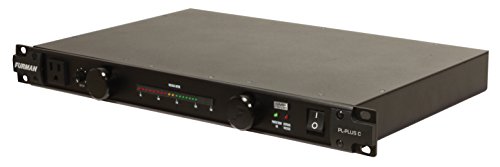
5. Furman PL-PLUS C 120V
Furman PL-PLUS C is the rack option for someone who wants a visible indication of incoming voltage as well as surge protection and filtering. The 120V, 15A unit provides nine outlets and pull-out lighting. Its front meter is useful for monitoring a venue supply without pretending that a display regulates the voltage.
This PL-PLUS C uses an LED voltage meter; it is not the digital voltmeter/ammeter DMC variant. It provides no battery backup, and total connected load must stay within its rating.
Pros
- A rack conditioner with lights and an incoming-voltage meter.
- 120V
Cons
- This PL-PLUS C uses an LED voltage meter; it is not the digital voltmeter/ammeter DMC variant. It provides no battery backup, and total connected load must stay within its rating.
| Selected voltage | 120V |
| Rating | 15A |
| Outlets | Nine |
| Meter | LED voltage display |
What does a Power Conditioner do?
A power conditioner can combine surge protection, line-noise filtering and power distribution. Only models with automatic voltage regulation correct specified supply-voltage fluctuations, and a separate UPS is needed for battery runtime.
Do I need a Power Conditioner for my home studio?
Decide which function your studio needs: more outlets, surge protection, voltage regulation or battery backup. A conditioner is useful for some of those jobs, but it does not solve every electrical or recording problem.
Choose a unit rated for the local mains voltage and the total connected load. A 120V US model is not interchangeable with a 230V EU model simply by changing the plug.
Do Power Conditioners reduce noise?
Line filtering can help with some conducted electrical interference. It will not automatically fix ground loops, noisy pickups, damaged cables or acoustic noise in the room.
What to look for in a Power Conditioner when buying?
You should look for a few key things when buying a power conditioner for your gear like sound quality, ease of use, protection, and the price.
Sound Quality
By sound quality, I’m referring to the active and successful filtering of electromagnetic and radio frequency noise. You want a conditioner that filters out any unwanted noise that may occur, naturally, a well-integrated filtering system and tech is something to look for.
Ease of Use
Anything can fall under ease of use, from something as simple as long power chords to something as vital as front and back switches. You also want a sufficient amount of outlets for your equipment. Anything that can ease the use and operation of the power conditioner should be considered.
Protection
Compare surge protection, shutdown behavior and load rating separately. Use a UPS when the equipment must keep running through a power cut; the conditioners in this list do not contain backup batteries.
Price
Spend according to the protection and distribution features you need. A more expensive unit does not guarantee better recordings.
Summary
Power protection and distribution should match the equipment and supply. Choose the rack or desktop format you need, and distinguish filtering from voltage regulation and battery backup.
My top power conditioner pick is the Furman M-8×2 8 Outlet Power Conditioner. It is a very efficient and compact power conditioner with great overall quality.
My budget power conditioner pick is the PDU Power Strip Surge Protector, if you want something more affordable that can do the job well.
Featured Image by: Travel dreamer / CC BY-SA