
A useful practice amp should sound good at your normal room volume and make it easy to start playing. Choose presets and effects for experimentation, simple controls for quick adjustments, or a battery model when portability matters.
If you want a small, portable guitar amplifier that will sound good at low volumes, then this is the article for you. So, what should you choose from the large selection available online? I made out a list of the 7 best practice amps.
My top recommended practice amp is the Fender Mustang LT25. A great value-for-price ratio with a sleek user interface, along with trademark Fender quality.
My budget recommendation is Blackstar FLY 3 Bluetooth – Black, the compact Bluetooth version for short practice sessions and phone backing tracks.
The 7 Best Guitar Practice Amps (2026)


Let’s compare these in more detail.

1. Fender Mustang LT25
Fender Mustang LT25 remains my first choice for a beginner who wants to explore several amp sounds and effects in one small combo. Its 25-watt amplifier and 8-inch speaker suit home practice, while the preset interface makes it easier to return to a useful sound. A headphone output supports quieter sessions.
Preset editing adds more decisions than a simple two-channel amp. It is mains powered and does not receive Bluetooth audio. Use the supported USB functions for this model rather than assuming every Mustang has the same recording or app features.
Pros
- Presets and effects for varied home practice.
- Power: 25 W; Speaker: 8 inches; Type: Digital modeling combo; Practice: Headphones; aux input
Cons
- Preset editing adds more decisions than a simple two-channel amp.
| Power | 25 W |
| Speaker | 8 inches |
| Type | Digital modeling combo |
| Practice | Headphones; aux input |

2. Blackstar FLY 3 Bluetooth - Black
Blackstar FLY 3 Bluetooth is the small practice option I would choose for a desk or travel bag. The black Bluetooth version combines a 3-watt amplifier, 3-inch speaker, clean/overdrive channels and delay. Bluetooth audio makes it easier to play along with a phone without using the guitar input for music.
Its small speaker cannot produce the low-end weight or output of a larger combo. This is the Bluetooth guitar model alone, not the FLY Bass, extension cabinet or stereo pack. Check whether the optional mains supply is included.
Pros
- A tiny battery amp with Bluetooth backing tracks.
- Power: 3 W; Speaker: 3 inches; Channels: Clean and overdrive; Playback: Bluetooth audio
Cons
- Its small speaker cannot produce the low-end weight or output of a larger combo.
| Power | 3 W |
| Speaker | 3 inches |
| Channels | Clean and overdrive |
| Playback | Bluetooth audio |
3. BOSS Katana-Mini X
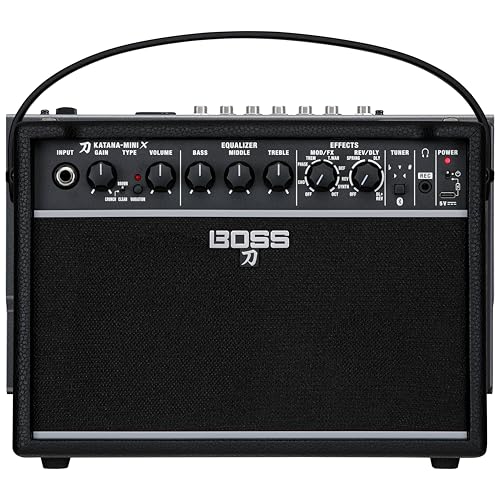
Katana-Mini X is my compact rechargeable option. Its 10-watt design and 5-inch speaker give you a small amp with clean, crunch and brown sounds, onboard effects and a tuner. Bluetooth audio handles backing tracks while the physical controls keep practice independent of an editing app.
It is not a USB recording interface or an app-controlled Katana combo. Follow the charging instructions and account for battery runtime. Choose a larger amp when rehearsing with an acoustic drummer.
Pros
- Rechargeable practice with physical controls and effects.
- Power: 10 W; Speaker: 5 inches; Power source: Internal rechargeable battery; Playback: Bluetooth audio
Cons
- It is not a USB recording interface or an app-controlled Katana combo.
| Power | 10 W |
| Speaker | 5 inches |
| Power source | Internal rechargeable battery |
| Playback | Bluetooth audio |

4. Orange Crush 20 - Orange
Orange Crush 20 is the straightforward choice for someone who wants to learn the amp controls rather than browse presets. The orange 20-watt combo has an 8-inch speaker, clean and dirty channels, and a three-band EQ. Its headphone output supports private practice and keeps the setup simple.
This is the Crush 20, not the 20RT: it does not include the RT model’s tuner and reverb. Add pedals if you need a wider effects palette. It needs mains power rather than batteries.
Pros
- A simple two-channel combo with direct gain control.
- Power: 20 W; Speaker: 8 inches; Channels: Clean and dirty
Cons
- This is the Crush 20, not the 20RT: it does not include the RT model’s tuner and reverb.
| Power | 20 W |
| Speaker | 8 inches |
| Channels | Clean and dirty |
| Model | Crush 20, orange |

Marshall MG30GFX is the option for someone who wants a familiar combo layout with more speaker area than a mini amp. Its 30-watt output, 10-inch speaker and clean-to-overdrive channels cover a useful range of practice sounds. Onboard effects let you experiment without immediately building a pedalboard.
It is less convenient to carry than the small battery models. Whether it is loud enough for a rehearsal depends on the drummer and room, not wattage alone. It is not a modeling USB recording system.
Pros
- A larger practice combo with onboard effects.
- Power: 30 W; Speaker: 10 inches; Channels: Clean, crunch and overdrive; Effects: Onboard digital effects
Cons
- It is less convenient to carry than the small battery models.
| Power | 30 W |
| Speaker | 10 inches |
| Channels | Clean, crunch and overdrive |
| Effects | Onboard digital effects |

6. Fender Champion II 25
Champion II 25 is the Fender alternative for someone who prefers turning knobs to managing presets. Its 25-watt amplifier, 8-inch speaker, selectable amp voices and onboard effects make a compact practice setup. Aux and headphone connections help with playing along and quieter listening.
It is mains powered and does not have Bluetooth streaming. Treat its physical controls as the attraction rather than expecting the Mustang software workflow. The Champion II generation is distinct from the old Champion 20.
Pros
- Simple voicings and effects without preset management.
- Power: 25 W; Speaker: 8 inches; Controls: Amp voices and onboard effects; Practice: Aux and headphone connections
Cons
- It is mains powered and does not have Bluetooth streaming.
| Power | 25 W |
| Speaker | 8 inches |
| Controls | Amp voices and onboard effects |
| Practice | Aux and headphone connections |

7. VOX Pathfinder 10
VOX Pathfinder 10 stays on the list for players who want a small amp with a direct control layout. Its 10-watt solid-state design and 6.5-inch speaker suit a bedroom, with a clean/overdrive switch and simple tone controls. The headphone/line connection offers another way to practice.
It has fewer effects and connection options than a modeling amp. It also needs mains power. Choose it for straightforward practice rather than assuming its appearance makes it a miniature tube AC-series amp.
Pros
- A small analog combo for uncluttered practice.
- Power: 10 W; Speaker: 6.5 inches; Type: Solid-state combo; Sound: Clean/overdrive switch
Cons
- It has fewer effects and connection options than a modeling amp.
| Power | 10 W |
| Speaker | 6.5 inches |
| Type | Solid-state combo |
| Sound | Clean/overdrive switch |
Do you need a Practice Guitar Amp?
Features vary by model. Some practice amps offer presets, recording or Bluetooth audio; others provide only the essential controls. Check the exact connections rather than assuming every small amp has wireless or app support.
Can you practice Guitar without an Amp?
Of course, you can. Electric or acoustic guitars emit enough sound for you to hear clearly, therefore, they are suitable for practice even without the aid of a practice amp. However, the practice amp is not just for loudness, it features much-needed modes, knobs, dials, effects, and sound-shaping that will make practice sessions more fun and effective.
Can you gig with a Practice Amp?
A small amp can work at a quiet show or through a microphone and PA. Its suitability depends on the band, venue and monitoring. A wedge or in-ear system can help you hear yourself, but neither is a universal requirement.
For louder bands, choose enough clean output and speaker capacity for the setting. Turning up a small amp may change its sound or reach its limits before the rest of the band is audible.
Should my Amp cost more than my Guitar?
The simple answer would be no. Not that it can’t, however, your guitar is the primary objective to scratch off the list before committing to a pricey amp. Of course, guitars can also be budget-friendly while some amps do have a steep price tag, especially vintage ones. My advice would be to get a good quality guitar if you have the budget for it then focus your efforts on an amp.
What to look for in a Practice Guitar Amp when buying?
If you’re a beginner looking to buy a first amp, you can be overwhelmed by the sheer magnitude of options you can have. And when you go online, you’ll find confusing advice as to what you really need.
Amp power
For home practice, usable low-volume control and a suitable speaker matter more than a wattage target. Rehearsals depend on the drummer, room and monitoring, so there is no universal wattage that guarantees enough output.
Also, as to power the amp, if you need your amp to go busking, you’ll want to get a battery-powered amp, but if you just want it to sit in one place, there’s really no need for that.
Tube vs. solid-state vs. digital
Even though you’re going to find that all of the top-level guitarists are playing stadiums on tube amps and also you’ll find some guitar amp purists saying that guitar can only be played on a tube amp.
You’ll probably do just fine with solid-state or digital sound amps for guitar practice. However, low-watt tube amps have become relatively inexpensive so it’s certainly worth checking those out.
Effects
Experienced guitarists almost always use effects using pedals. However, building a pedalboard is an expensive task, where one or two pedals might cost as much as your whole practice amp. So, if you’re a beginner, you might want to get an amp with at least some effects on it, as it will get you to know basic effects and how they affect your tone when playing, which is important when you’re learning to play electric guitar. Naturally, effects like reverb, delay, tremolo, and others make playing way more fun!
Summary
Choose the amp you can use comfortably at home. Keep the setup simple enough to encourage practice, then add recording, effects or battery operation when you have a use for them.
My top practice amp pick is the Fender Mustang LT25. This amp offers great value for your money along with a sleek user interface and trademark Fender quality.
My budget practice amp pick is the Blackstar FLY 3 Bluetooth – Black, an affordable practice amp with great overall quality that will get the job done.