
Delay pedals come in various types like tape echo, analog, and digital delay. They can create ambient, rhythmic, and other sound effects. Some pedals include a “tap tempo” switch, letting you set the delay time by tapping the tempo.
Tap tempo delay pedals are highly useful for musicians. Setting your own delay time by tapping is simpler and more effective.
My top pick for a tap tempo delay pedal is the EarthQuaker Devices Avalanche Run V2. It offers excellent value and is highly functional and durable.
My second recommended tap tempo delay pedal is the NUX Time Core Deluxe MKII, one of the best budget-friendly options available.
The 7 Best Tap Tempo Delay Pedals (2026)


Let’s compare these in more detail.
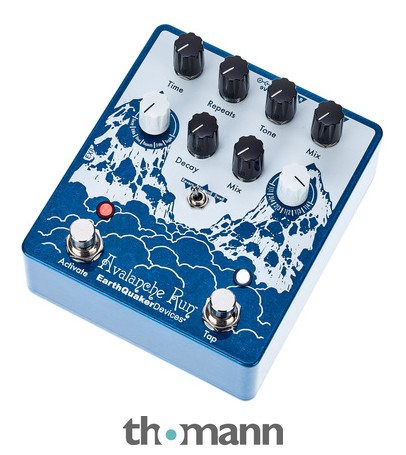
1. EarthQuaker Devices Avalanche Run V2
1. EarthQuaker Devices Avalanche Run V2
Best delay and reverb pairing
Avalanche Run V2 combines stereo delay and reverb with a dedicated tap-tempo workflow. It is the most appealing all-round choice here for spacious playing where one pedal must cover rhythmic repeats and ambience.
It occupies more space and costs more than a simple delay. A player who needs stored patches or MIDI program control should compare the DD-200 and Metaverse instead.
Pros
- Delay plus reverb
- Stereo tap-tempo workflow
Cons
- No broad preset library
| Effects | Delay and reverb |
| I/O | Stereo |
| Version | V2 |

2. NUX Time Core Deluxe MKII
2. NUX Time Core Deluxe MKII
Best value with onboard tap
The Time Core Deluxe MKII replaces a Flashback 2 offer that is unavailable at Amazon and out of stock at Sweetwater. NUX gives this compact pedal seven delay types, stereo operation and Smart Tap Tempo from its footswitch, so it fits the budget role without requiring a separate tap switch.
The footswitch shares bypass and tap duties, which takes practice on stage. The Flashback 2 remains a good pedal, but its available Thomann page currently shows a wait rather than immediate stock.
Pros
- Onboard tap tempo
- Seven delay types and stereo looper
Cons
- Shared footswitch takes practice
| Delay types | 7 |
| Looper | 40-second stereo phrase |
| Power | 9 V DC |
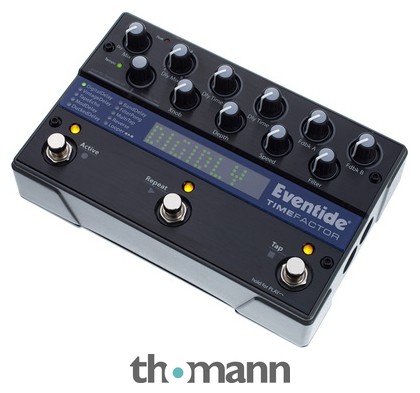
3. Eventide TimeFactor Twin Delay
3. Eventide TimeFactor Twin Delay
Deep dual-delay control
TimeFactor remains a strong specialist choice for players building layered rhythmic delays and saving stage presets. Its twin-delay architecture and broad controls reward time spent programming rather than quick set-and-forget use.
The menu depth and footprint are unnecessary for a simple slapback. The exact new Amazon and Sweetwater catalog offers are still buyable, so an age-based swap would not improve this role.
Pros
- Two delay engines
- Preset-oriented performance
Cons
- Large learning curve and footprint
| Architecture | Twin delay |
| I/O | Stereo |
| Model | TimeFactor |
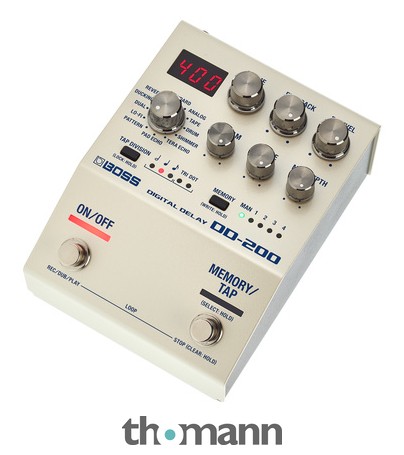
4. Boss DD-200 Digital Delay
4. Boss DD-200 Digital Delay
Versatile compact performance delay
DD-200 balances multiple delay sounds with a readable display and tap-tempo control. It is a practical choice when one compact unit must move among several sounds on stage.
Its menu and preset workflow is more involved than the MXR analog pedal. The old Sweetwater identity currently reports out of stock, so the active exact offer is the new Amazon DD-200.
Pros
- Tap tempo and multiple delay modes
- Compact preset workflow
Cons
- More controls to learn
| Type | Digital delay |
| Control | Tap tempo |
| Model | DD-200 |
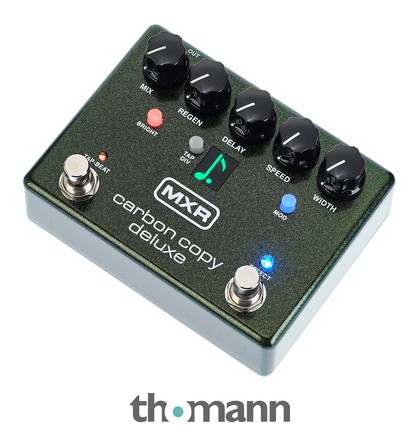
5. MXR Carbon Copy Deluxe M292
5. MXR Carbon Copy Deluxe M292
Best analog tap-tempo character
The M292 adds tap tempo and subdivision control to the dark analog-repeat character of Carbon Copy. It is the right choice for players who want analog delay feel and quick rhythmic changes rather than a large bank of digital algorithms.
Do not confuse this Deluxe M292 with the smaller standard Carbon Copy M169, which has a different control set. Its analog range and repeat tone are part of the appeal but limit extreme clean or long delays.
Pros
- Analog repeats with tap
- Subdivision control
Cons
- Narrower palette than digital multi-delay
| Type | Analog delay |
| Control | Tap tempo |
| Model | M292 |

6. Electro-Harmonix Canyon Delay and Looper
6. Electro-Harmonix Canyon Delay and Looper
Small footprint with many modes
Canyon combines several delay voices and a looper in a compact box with tap-tempo operation. It suits a player who wants variety without moving to the larger Eventide or Wampler units.
The old Amazon listing bundled a Dunlop pick pack, so it is not paired with the standalone Sweetwater item. The exact Canyon pedal remains in stock through the verified Sweetwater catalog.
Pros
- Many delay sounds in a small box
- Integrated looper
Cons
- Secondary functions need practice
| Type | Digital delay/looper |
| Control | Tap tempo |
| Model | Canyon |

7. Wampler Metaverse Multi-Delay
7. Wampler Metaverse Multi-Delay
Best modern tape-style and MIDI option
Metaverse replaces Wampler's discontinued Faux Tape Echo V2. It carries a Faux Tape Echo-inspired program among eleven delay modes, adds tap tempo, stereo I/O and MIDI control, and better serves a player building a flexible current rig.
Its digital multi-effect approach is broader and more complex than the old single-purpose hybrid pedal. The Wampler Catacombs is another current option, but its reverb pairing overlaps the Avalanche Run role.
Pros
- Faux Tape Echo-inspired mode
- Tap, presets and MIDI
Cons
- More setup than a single-mode delay
| Delay programs | 11 |
| Presets | 8 onboard |
| I/O | Stereo |
What is a Tap Tempo Delay Pedal?
The tap tempo function on delay pedals lets you quickly set the tempo of the delay, which can be very beneficial in various situations.
Guitarists who perform live a lot will benefit from a tap tempo function on their delay pedals. It lets them quickly change tempo without wasting time adjusting settings between or even during songs.
What is the difference between Digital and Analog Delay Pedals?
Analog bucket-brigade delays often darken successive repeats, while digital designs can offer clean repeats and several modeled characters. Neither design is inherently better. Compare delay range, tap subdivisions, stereo routing and whether a pedal preserves tails when bypassed; the exact model matters more than a broad analog-versus-digital label.
Analog delay pedals use a bucket brigade device (BDD), passing the analog signal through capacitors. Each cycle increasingly breaks up the sound, creating that distinct “warm sound” unique to these pedals. Their delay times are usually shorter, typically around 1 second or less.
Digital delay pedals convert the signal from analog to digital and back again, which some believe alters your guitar tone. These pedals offer longer delay times, consistent repeats, and many settings to fine-tune your sound.
Does True Bypass play a significant role in Tap Tempo Delay Pedals?
True bypass and buffered bypass serve different rigs. A buffer can help a long cable run, and trails or spillover may require a buffered signal path. Test the whole board for noise, level and high-frequency loss rather than assuming one bypass type always preserves tone better.
Using true bypass pedals in your pedalboard ensures the cleanest signal, preventing any tone loss from the guitar. If your pedal lacks true bypass, you can modify it to maintain signal quality.
What to look for in a Tap Tempo Delay Pedal when buying?
First decide how you will tap tempo on stage: a dedicated switch, a shared switch or an external footswitch. Then compare subdivisions, presets, delay tails, mono or stereo routing and power requirements. Extra reverb or looping is useful only if it suits your set and pedalboard.
Durability, playability, and build quality are key factors when choosing a pedal. Even if it has the right settings, a lack of durability and good construction might mean it’s not the best choice.
Many tap tempo delay pedals come with extra features like reverb and looper. If you already own reverb pedals or loopers, there’s no point in paying more for features you won’t use. Learn more about looper pedals.
Conclusion
Many tap tempo delay pedals are available, and getting the right one is crucial. They offer great versatility compared to other effect pedals. Tap tempo delays are found on nearly every session or live guitarist’s pedalboard, regardless of genre.
My top pick is the EarthQuaker Devices Avalanche Run V2. This pedal offers excellent value, featuring outstanding functionality and durability.
My budget pick is the NUX Time Core Deluxe MKII, a reliable and affordable delay pedal.