
Udu drums traditionally made from clay resemble water pots. Many have an opening on top and another on the side. By tapping or palming the openings and body, you create different sounds.
Udu drums come from Nigeria, specifically the Igbo people, so they’re often called Igbo or Ibo drums. Here, I’ll list 5 of the best Udu drums.
My top recommended udu drum is the Meinl ID4BKO Tri Sound Ibo Drum Black Ornament. This fiberglass Ibo drum combines opening pulses with an additional playing surface.
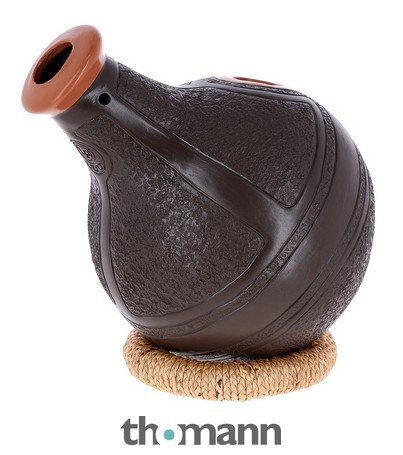
My second recommended udu drum is the Latin Percussion LP1400-C3 Claytone #3. It’s a conventional clay option with textured surfaces and a support ring.
The 5 Best Udu Drums (2026)



Let’s compare these in more detail.
1. Meinl ID4BKO Tri Sound Ibo Drum Black Ornament
Meinl's ID4BKO is a useful alternative to a clay-bodied udu. The Black Ornament version has a fiberglass shell and an extra fiberglass playing surface, so you can combine air pulses at the openings with finger taps on different parts of the body. It keeps the original recommendation's varied playing-surface role without treating fiberglass as a guarantee of clearer or better sound than clay.
The built-in microphone hole provides a practical route for close recording, although microphone choice and position still matter. A foam padded base is included to support the instrument. The base is a support accessory, not an additional tuned playing head, and you should place the drum securely before using both hands.
This is the ID4BKO Tri Sound model, not the similarly shaped ID3GO with its rawhide playing surface. Choose between them according to the sounds and techniques you want. The resistant fiberglass construction can be helpful when transporting percussion, but protect the openings and playing surfaces in a suitable padded case.
2. Latin Percussion LP1400-C3 Claytone #3
The LP1400-C3 Claytone #3 keeps the familiar clay-vessel approach. Developed by ceramicist Frank Giorgini, it offers body taps, opening strikes and rubbing techniques on textured surfaces. That range makes it a useful starting point for someone exploring how hand position changes an udu's response, without needing an additional skin head.
The #3 is the medium model, approximately 15 inches high and 10 inches in diameter, supplied with a support ring. Check those dimensions against your seated playing position and the space in your percussion setup. The Claytone #4 is a different, larger instrument, so a photograph or offer for that version should not be treated as the same purchase.
The clay body should be handled carefully and supported on its ring or a cushioned surface. Begin with light fingertip patterns and gentle palm pulses before adding stronger accents. It is an accessible conventional design for beginners, but the useful distinction here is its construction and size rather than a claim that it is always the cheapest option.
3. Latin Percussion LP1400-HG Hadgini
Frank Giorgini developed the Hadgini in collaboration with percussionist Jamey Haddad. Its two connected chambers give each hand a different area to work with, making it an interesting choice for interlocking figures and experiments with alternating accents. It is a clay instrument with two chambers, rather than a pair of conventional skin-headed drums.
You can strike the openings and body, and use the textured surfaces for rubbing sounds. Different shapes and contact points provide contrasts within a single instrument. Listen to the manufacturer's demonstration to understand that range, then consider whether the layout suits your own hand positions and percussion vocabulary.
The Hadgini has no membrane heads; its rubbing textures come from the clay surfaces. Players familiar with hand-drum heel-and-tip patterns may find useful ways to adapt them, but the vessel's air response differs from a conga or tabla. Support both chambers securely and experiment gently rather than assuming that a larger layout automatically produces more volume.
4. Schlagwerk U62 Basic Udu
Schlagwerk makes several udu designs, including bass, neck, twin and skin models. The U62 Basic Udu remains a sensible choice for someone wanting the straightforward clay-vessel format. It follows the larger U60 Bass Udu's shape in a smaller size, keeping this recommendation distinct from the two-chamber Hadgini.
The U62 is handmade in Germany from clay and includes a support ring. Its approximate dimensions are 35 centimetres high and 27 centimetres across, so it still needs room in a seated setup. Handmade construction is a concrete feature; it does not establish that only professionals can use it or that comfort and sound will be perfect for every player.
Compare the body and opening responses in Schlagwerk's demonstration with the techniques you want to learn. A ring supports the vessel, while a padded bag helps protect it during transport. MUSIC STORE offers US delivery through its import service; allow for shipping and any import duties before ordering. For an EU alternative, percussion+m lists domestic German delivery, with other EU destinations available on enquiry.
5. Latin Percussion LP1400-UT Utar
The LP1400-UT is the Utar, a saucer-shaped clay udu with a pronounced bell. That shape gives you a different playing layout from the upright Claytone. It can be useful when you want to combine short opening pulses with tonal accents on the extended bell, rather than simply choosing another conventional pot shape.
Like the other LP clay models, its body and textured surfaces can be struck or rubbed by hand. The response depends on where and how you contact the vessel, how you cover the openings and the acoustic or amplified setting. The low tones are one part of its range, not evidence that it will always project more strongly than every other udu.
Check the model code carefully: Utar is LP1400-UT, while Tambuta is a separate instrument. The current exact purchase route here is for a new Utar. Its unusual layout can interest experienced percussionists, but a patient beginner can also explore it; previous professional experience is not a requirement.
What are udu drums?
Udu drums are clay instruments from Nigeria, crafted by Igbo women to resemble water jugs, originally used during ceremonies.
How to play udu drums?
Udu drums can be played using various techniques. Use your fingers to beat the drum, producing an almost bongo-like sound.
Palming the udu drum produces deeper, richer sounds. By controlling the two holes, you can fine-tune the sound. Changing hand position alters the air pulse and pitch response, while body taps add contrasting rhythmic accents.
Where are udu drums used?
Udu drums appear in acoustic ensembles, recorded percussion arrangements and jazz or other contemporary music settings. A close microphone can help capture their quiet details alongside louder instruments.
Percussionist Jamey Haddad collaborated with Frank Giorgini on the Hadgini. That design is one example of contemporary development alongside the instrument’s Igbo tradition.
Their opening pulses and finger-tapped textures can also sit alongside electronic arrangements. Try a sparse rhythmic part before adding processing, so the contrast between low air sounds and sharper body accents remains clear.
Conclusion
Whether you know what udu drums are or not, this is an amazing instrument to explore. There are various udu drums available, and I believe these 5 options will meet your needs. These instruments can introduce you to new musical techniques and experiments. Respect their Igbo origins while exploring the different modern constructions.
Whether you’re an amateur looking to get into percussion or a professional expanding your collection, you’ll find something for you on this list.
My top udu drum pick is the Meinl ID4BKO Tri Sound Ibo Drum Black Ornament. Its fiberglass shell, extra playing surface and microphone hole give it a practical combination of features.
My conventional clay udu pick is the Latin Percussion LP1400-C3 Claytone #3. It offers a familiar vessel shape and textured surfaces for learning hand-percussion techniques. Check the exact model and delivery arrangements before ordering.
Featured Image Credit: http://muzyczny.pl / CC BY-SA