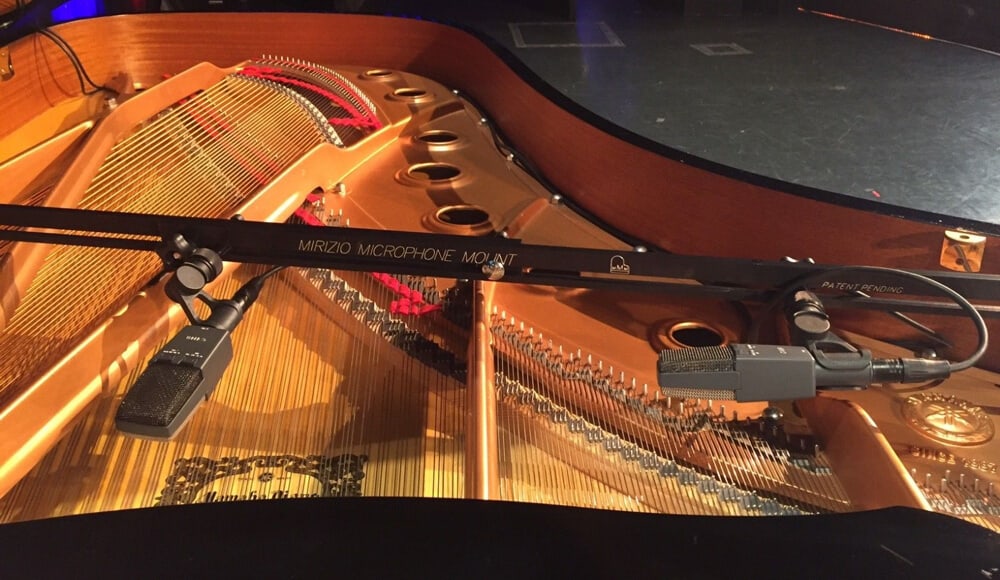
Looking at the numerous options of what is available today in music stores for a grand piano microphone mount is quite overwhelming.
It would be better not to look at the choices if you do not know where to start or what should be considered. To avoid getting something that will not precisely fit your needs, it is best to be informed first. This guide will not only aid you in choosing the best accessories for your grand piano. It will also assist you in ensuring that your flawless performance can be heard clearly, whether for a live audience or for recording purposes.
Most musicians would acknowledge that the grand piano is one of the fussiest instruments out there, and the microphones used should be able to match its requisites. There are even special types of microphones that are designed explicitly for grand piano performances. The right positioning of the mic over the strings and hammers would result in an amazing sound that even the lightest or the heaviest pressing of the keys can be heard clearly.
Smart mic positioning alone will not save the take if the hardware is shaky. The mount and clips also need to be built from high-grade materials, otherwise feedback or buzzing can creep in and spoil an otherwise good performance.
User & Buyer’s Guide: Why & How To Use Mirizio’s Grand Piano Microphone Mount?
The grand piano can be heard generally from just a few feet away, and so it needs to be reinforced. Sounds from a piano have to be isolated to be clearly heard, and that would require having the microphone closer to its source. Some music engineers would position the microphone about a couple of feet above the strings, but there are those who prefer to position it as near as six inches to the strings. A stable and durable grand piano mount such as the Mirizio’s Grand Piano Microphone Mount is most suitable for the job.
American Leonard Mirizio developed this mount from years of experience in the audio business. The Mirizio’s Grand Piano Microphone Mount concept may be similar to other mounts. Instead of using regular steel tubes, he used black-anodized flat bars that are more stable when placed on any surface.
Many engineers reach for a stereo pair rather than a single mic, and the ORTF setup is a popular starting point: two cardioid capsules spaced 17 cm apart and angled outward at 110 degrees, which roughly mimics how human ears sample a sound stage. The technique was worked out in the 1960s at Office de Radiodiffusion Television Francaise, the French national broadcaster the initials refer to.
The unique design and mechanism have removed the need for clamping tools or for those huge sticky tapes that can permanently damage the piano’s woodwork. The mic slots provided on the flat bar eliminate the need for another mount if there is an additional microphone to be placed. While positioning the mics inside a grand piano requires great care, Mirizio’s Grand Piano Microphone Mount was engineered in such a way that it can be handled by just one person. There are no other tools needed except for the mount and the microphones. Re-adjusting the placement of the mics can be done quickly due to the railing mechanism. Just slide them up and down to achieve the required position.
Taking the mount apart is just as quick as putting it together. The bolts stay attached to the aluminum bars thanks to the Velcro straps included in the kit. Push the bars back to their starting position, then turn the end plates so they line up with the clamped bars and the whole rig is ready to pack away. The price tag sits a little higher than some rival mounts, but few products make miking a grand piano this painless.
In today’s fast-paced digital landscape, staying productive can be a challenge. I’m here to share some practical tips and tools that can supercharge your efficiency and help you get more done with less effort.
Top Grand Piano Microphone Mount Recommendation

The grand piano microphone mount from Mirizio offers a unique mic piano holder where it can be placed inside the piano even with its lid closed. The mount comes with two retractable flat aluminum black bars clamped together with swiveling plate on both ends with felt pads on one side of each plate. It can be positioned inside the piano effortlessly anywhere by just extending the steel bar to the required distance. The knobs are easily tightened to keep the mount in place. One can also easily slide the mic clip in any of the slots in the rail to a strategic position across the piano. Each microphone slot has its own bolt and jam nut to make sure the microphone stays in place.
The retractable aluminum black bars can extend from 37 inches to 62 inches. The felt pads on each plate would protect the piano from any dents or damage to its woodwork and, at the same time, avoid any chance of tilting to any side. There is no need for screwdrivers or other tools as the bolts and nuts can easily be tightened and removed by using only the hands.