
Loop pedals capture a phrase and play it repeatedly, leaving you free to add another part. Compact digital loopers became familiar pedalboard tools in the 1990s and opened up new possibilities for solo performance and practice.
Today, you can choose from dozens of looper pedals. This list showcases 7 top options, from affordable, compact ones to high-end models.
My top recommended looper pedal is the BOSS RC-5 Loop Station. This compact stereo pedal offers 13 hours of total phrase storage, with up to about 1.5 hours for one track.
My second recommended looper pedal is the LEKATO M00776 Looper. If you want something affordable yet satisfying, the LEKATO is one of the best options.
The 7 Best Looper Pedals for Guitar (2026)




Let’s compare these in more detail.
1. BOSS RC-5 Loop Station
Another all-in-one compact pedal, the BOSS RC-5 Loop Station is a strong choice for players who want saved backing parts and rhythm accompaniment without moving to a large floor unit. Its display shows the recording state and gives access to settings that would be difficult to manage with only a status light.
First, there is approximately 13 hours of stereo recording storage across 99 phrase memories. One track can be about 1.5 hours long, so the total storage figure is not the length of a single loop. You can save a progression for practice, then recall a different phrase without rebuilding your complete backing part.
Additionally, the RC-5 offers 57 preset rhythms with two variations and seven drum kits. Auto-recording and a count-in are useful ways to start, while reverse playback adds a creative option. These features support practice, but accurate playing and closing the loop still matter. The embedded video demonstrates the earlier RC-3, whose rhythm and connectivity specifications differ.
For connectivity, there are separate quarter-inch left and right inputs and outputs, USB for backing up or loading WAV loops, and mini-TRS MIDI input and output. MIDI can synchronize an appropriate drum machine or control setup. There is no RC-3-style auxiliary input, and USB file transfer should not be confused with a USB audio interface.
All in all, the RC-5 suits someone who values recall, stereo routing and external control. It remains a single loop track with overdubs rather than a multitrack workstation. A compatible external switch can make stopping or changing functions more convenient; budget for the correct cable and switch rather than assuming they are included.
Alternative options from BOSS include the simpler RC-1 for straightforward looping, the RC-10R for a rhythm-focused arrangement, and the RC-600 for a much larger multitrack performance system. Choose according to the number of parts you need to control, rather than storage capacity alone.
2. LEKATO M00776 Looper
Next, the compact LEKATO M00776 is a straightforward choice for players who mainly want a repeating backing phrase. This is the five-minute, single-loop version. LEKATO also sells models with more memories or a tuner, so check the model rather than relying on the brand name alone.
The pedal has one level knob and a single footswitch. That keeps the controls simple, but recording, playback, stopping and undoing share the switch. Practise the required taps and holds before using it in a performance, especially if you are used to a separate stop button.
Regarding connections, it has quarter-inch mono input and output plus a Micro-B USB port for transferring loop files using the maker's supported software. File transfer is useful for preparing a backing phrase; it does not make this pedal a general-purpose computer audio interface. Check software compatibility before buying specifically for that workflow.
Looping allows up to five minutes and additional overdub layers. The first pass establishes the repeating phrase length, so record the complete progression you want before adding a shorter melody. The original M00776 offer is the pedal rather than a separate power-supply bundle. Arrange a compatible 9V centre-negative supply and check the seller's package contents.
This is a useful simple practice tool if its mono routing and shared footswitch suit you. It does not provide the RC-5's rhythm section, MIDI control or bank of phrase memories. That narrower feature set can be an advantage when you want to record a chord progression and start practising without navigating menus.
3. Line 6 DL4 MkII
The Line 6 DL4 MkII combines looping with a broad selection of delay sounds. It suits a player who wants both jobs in one pedal rather than only a backing-track recorder. There are 30 delay models, with familiar legacy options and newer HX-derived sounds, plus additional reverb settings for more elaborate textures.
The main looping choice is between the four-switch Classic Looper and the assignable one-switch looper. These are two ways to control the same loop, not two independent tracks. At full speed, internal recording is up to 120 seconds in mono or 60 seconds in stereo. Classic Looper half-speed operation doubles those figures.
Controls for delay time, repeats and mix keep the main sound shaping accessible, while deeper settings take more preparation. A compatible optional microSD card extends recording to hours and preserves a loop across power cycles; internal-memory loops disappear when power is removed. The embedded demonstration is of the discontinued Memory Man with Hazarai, providing historical delay/loop context rather than a DL4 MkII control tutorial.
For connectivity, there are stereo quarter-inch inputs and outputs, an XLR microphone input, MIDI input and output/thru, and external expression or footswitch options. USB-C handles MIDI and updates, not audio recording into a DAW. Use the supplied DC-1g adapter or a correctly specified 9V centre-negative supply; this model does not run on batteries.
This is the more involved option for guitarists who want to alternate between delay textures and looping, or include an appropriate microphone source. Classic Looper mode uses its own echo rather than the selected delay preset, while one-switch looping can run alongside presets. It is worth learning that distinction before planning a performance around simultaneous effects.
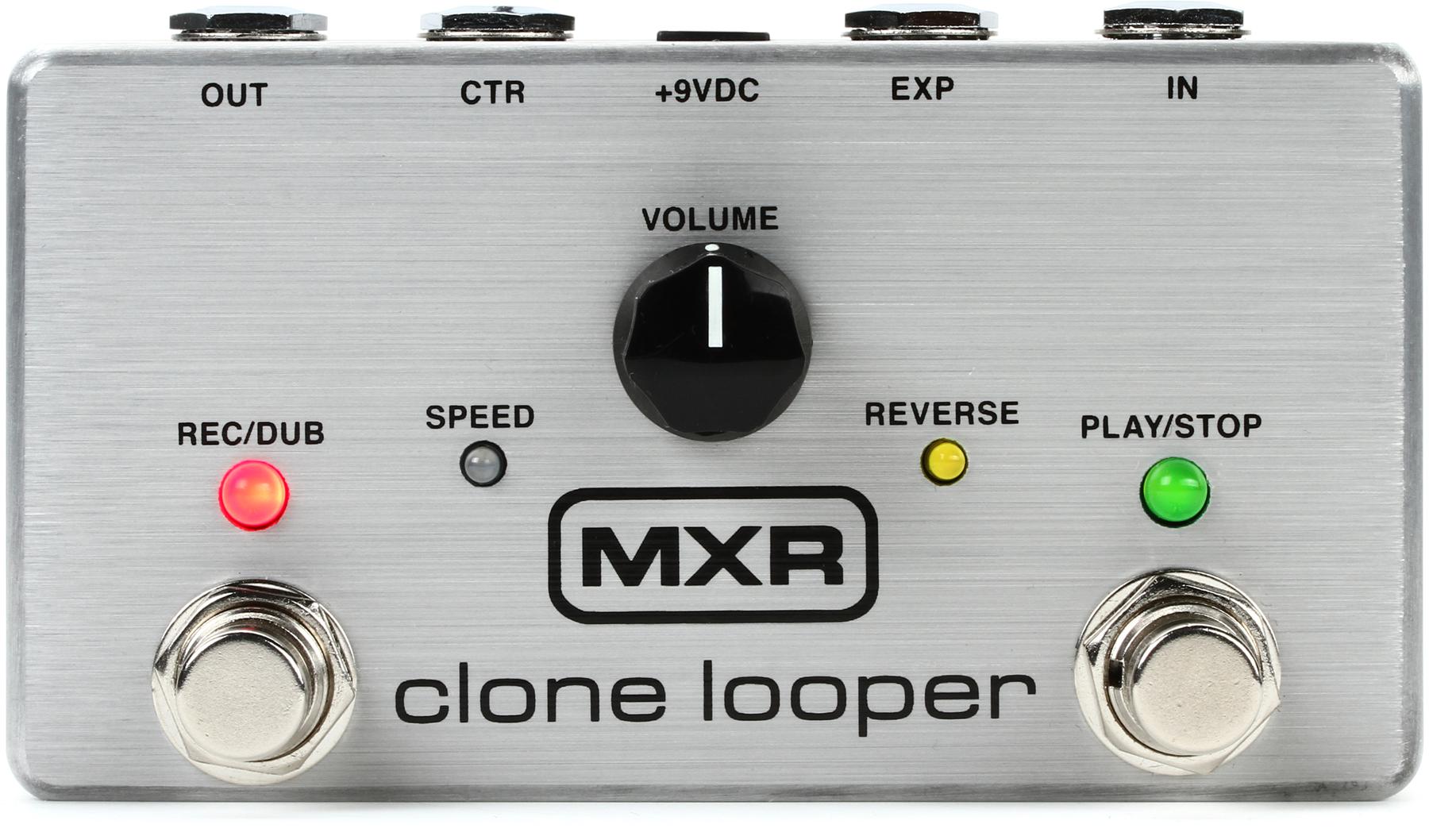
4. MXR M303 Clone Looper
The MXR M303 Clone Looper provides up to six minutes of recording with overdubs in a compact mono pedal. You can play a loop at normal, half or double speed, or reverse it. These changes affect the recorded phrase, making it suitable for textures and experiments as well as ordinary rhythm-guitar backing.
The metal enclosure has one volume knob and separate REC/DUB and PLAY/STOP footswitches. Having separate switches can make live control easier to follow than a single-switch sequence, although undo, redo and clearing still involve specific holds. The playback indicator also provides a four-count cue when adding another layer.
This pedal features quarter-inch mono audio input and output plus CTR and EXP control jacks. They are not an extra stereo audio pair. An appropriate tap switch can control speed or direction; an expression pedal can adjust loop volume. Check the manual's cable and switch requirements for the function you want.
The Clone Looper is a sensible fit if you want hands-on loop manipulation without a full song-memory system or onboard drums. Its loop remains stored after power removal, but it is not a bank of independently selectable songs. Use a suitable 9V supply with adequate current, and allow for its 225mA draw; batteries are not supported.
5. Pigtronix Infinity 2
Check out the Pigtronix Infinity 2 if you want to build separate song sections rather than pile every overdub onto one continuous backing part. Its two loops operate sequentially for a verse-and-chorus arrangement. They are not two parallel tracks that always play together, which is an important distinction when planning your set.
The two main knobs set loop volume and the decay of older material during overdubbing. With decay turned fully up, layers remain; lower settings progressively replace earlier material. Each main footswitch normally controls its corresponding loop, and many transitions can be queued for the end of the current cycle rather than requiring a precisely timed tap.
Besides the double-loop arrangement, the left footswitch can handle stopping, one-shot playback, octave changes or undo/redo workflows. Changing sample rate also changes playback speed and pitch, rather than adding a separate pitch effect to your live guitar. Study the mode instructions before switching: some normal undo-mode changes clear the current audio.
For connectivity, the Infinity 2 provides stereo quarter-inch inputs and outputs, an optional TRS remote connection and Micro-B USB for firmware updates. USB is not a loop-library connection or audio interface. The pedal uses a 9V centre-negative supply and has no MIDI synchronization. It suits hands-on sequential performance; players needing MIDI control or a recallable song archive should compare a more elaborate looper.
6. Donner Triple Looper
The Donner Triple Looper is a compact choice if you want to keep a few longer backing phrases ready for practice. It has three memory slots with up to 30 minutes in each. These are separately selected recordings, not three tracks playing together as a multitrack arrangement.
A single footswitch handles recording, playback, overdubbing, stopping and clearing, while the small screen shows the operating state and loop progress. The selector chooses the memory slot. Learn the stop and clear gestures before performing so that a long press does not remove a phrase you intended only to pause.
Donner's manual describes automatic retention of recorded material after power is removed, useful when returning to a practice session. The pedal is mono and does not offer the MIDI, drum patterns or USB import facilities of larger designs. More recording minutes cannot replace those functions if your setup needs them.
If those limits fit your needs, the Triple Looper gives you more saved practice material than a single-memory mini pedal. Use a 9V centre-negative supply and check the current instructions supplied with your unit: the manual lists 300mA, while the maker's product-page note recommends a supply rated for at least 500mA. Do not assume a supply is included with the pedal.
7. TC Electronic Ditto 2 Looper
The TC Electronic Ditto 2 Looper keeps the simple compact approach of the original while adding more control over how looping works. It offers up to ten minutes of recording and a larger magnetic footswitch. The DITTO profile retains familiar recording and overdubbing operation; the USER profile can be configured to suit a different practice routine.
Ditto 2 runs from a 9V centre-negative supply rated for at least 100mA, sold separately, and cannot use a battery. Its mono input and output suit a simple guitar-to-amp arrangement. The embedded video shows the original five-minute Ditto, so it demonstrates the general idea rather than the new model's switch, profile and app features.
LoopSnap analyses a recorded phrase and corrects small timing mismatches at its boundary. It is optional rather than a promise to fix every rhythmic mistake. The TC App connects through Bluetooth or USB-C for USER settings, bypass selection and firmware updates. Bluetooth here is configuration, not wireless guitar-audio transmission.
For straightforward practice, select the classic profile and add overdubs to your backing phrase. For a quicker record/play/delete cycle, the USER profile can provide SingleTap operation without overdubbing in that sequence. The ability to choose between those approaches is the main attraction; players needing independent song sections, stereo audio or MIDI should choose another design.
How do Looper Pedals Work?
Looper pedals are now very popular, especially for live performances. Musicians and guitarists can do a whole show solo. The looper pedal records audio chunks that you play and repeats them, creating a backing track. You can then add layers of melodies and vocals to build an entire song by yourself.
Most looper pedals feature one or two footswitches. These controls let you capture audio, play it back, and stop playback. Some pedals offer extra effects and options like tap tempo and sync.
Where does a Looper Pedal go in the signal chain?
Most guitarists put the looper pedal at the far end of their signal chain. Having the looper pedal there means all other effects like delay, reverb, and overdrive go before it, shaping the looped sound. Experiment with different placements to see what works for you or even skip effects you don’t want looped by placing the looper before them.
What to look for in a Looper Pedal when buying?
When buying a looper pedal, focus on the design, loop time, memory slots, and loop tracks.
Design
Looper pedals usually come with one or two footswitches. A single footswitch looper is more compact and won’t take up much space on your rig but is harder to use because one footswitch controls all your options. It typically follows a sequence of steps for recording, playback, stop, undo, redo, and more.
Using two footswitches can simplify control by separating functions, but the assignment varies by model. One may handle stopping, another recording, or each may select a different loop. Check the actual operation rather than assuming all two-switch pedals work alike; allow enough space to press the intended switch comfortably.
Loop Time/Memory
Years ago, looper pedals had limited recording time. Today, they can store hours of music. Always get a looper pedal with adequate loop time for your needs.
Memory slots are useful if you want to recall different backing parts. Overdub layers are not separate song memories: the MXR records layers into one repeating loop, while the BOSS RC-5 stores up to 99 phrases. Its 13-hour capacity is total storage, with about 1.5 hours maximum for one track. The DL4 MkII needs a suitable optional microSD card to preserve its loop after power is removed.
Loop Tracks
Single-loop track loopers repeat one phrase with additional overdubs. They suit practice, adding a backing part in a band, and some solo performances. A single-track model may still include many saved phrases, rhythms or external controls, so check the complete feature set rather than judging only by the track count.
Double-loop track loopers provide separate parts, but their relationship matters. Some play tracks together; the Infinity 2 plays its two sections sequentially for a verse/chorus arrangement. Independent lengths, synchronization, separate level controls and MIDI are model-specific features. Choose the arrangement you intend to perform, then learn how to cue changes without accidentally clearing material.
Conclusion
Looper pedals are common in genres like psychedelic rock, funk, jazz, and modern experimental music. They’re great for solo performers and are handy in studios, including home setups for songwriters.
My top looper pedal pick is the BOSS RC-5 Loop Station if you want stereo looping, rhythm accompaniment and saved phrases, with 13 hours of total storage rather than a single 13-hour loop.
My budget looper pedal pick is the LEKATO M00776 Looper. If you want an affordable option that works well, this is it.