
The Best Violin Strings for Beginners

If you’re looking for the best violin strings for beginners, you’ve come to the right place! Here are our top picks:

1. Thomastik Dominant 135B, 4/4 medium
The Thomastik Dominant 135B medium set is a full set for a 4/4 violin. Its A, D and G strings have synthetic cores, while the E is unwound stainless steel with a removable ball end. This distinction matters if your E fine tuner needs a loop instead of a ball. Dominant is a useful starting point when you want to try a synthetic set, although its response and tone will still depend on your violin and bowing. You can combine strings from different sets with your teacher’s advice; there is no need to experiment with mixed tensions before you have a dependable setup.

2. D'Addario Helicore H310 4/4M
D’Addario Helicore H310 4/4M uses a stranded steel core for the lower strings and a plain steel E. The cable-like core offers a different feel from solid steel or synthetic strings. Helicore is worth considering if you want a steel set with a flexible feel and a clear response, including for fiddle styles. It is also suitable for students who prefer that response during regular practice. A smaller diameter does not make a string better on every instrument, so use its medium tension specification rather than appearance alone when comparing sets.
This particular Helicore set is sized for a 4/4 violin and has ball ends. Check your tailpiece and fine tuners before ordering, especially the E attachment. The sealed packaging helps protect unused strings, but installed strings still wear with playing, perspiration and cleaning habits. The range has other sizes and tensions; the listing reviewed here is the medium H310 4/4M full set, not a single replacement string, a heavy set or an octave violin set.
3. Fiddlerman synthetic violin string set, 4/4–3/4 medium
The Fiddlerman set contains G, D, A and E strings. Its A, D and G strings use synthetic Perlon cores; the E is plain steel. The reviewed medium set is labeled for 4/4 and 3/4 violins, and other fractional sizes are sold separately. Check the specific packet rather than assuming every Fiddlerman listing fits both sizes. Its E ball is removable, which can help match a loop-end fine tuner, but ask your teacher for help if you are unfamiliar with the fitting.
Fiddlerman is a sensible synthetic alternative to compare with Dominant when your budget matters. It does not follow that the two sets will sound identical on your violin, or that a beginner must use one particular brand. Try a complete set first and make a note of how easily notes start, whether tuning settles and how the strings feel under the fingers. Those observations are more useful than an unsupported promise of professional tone.
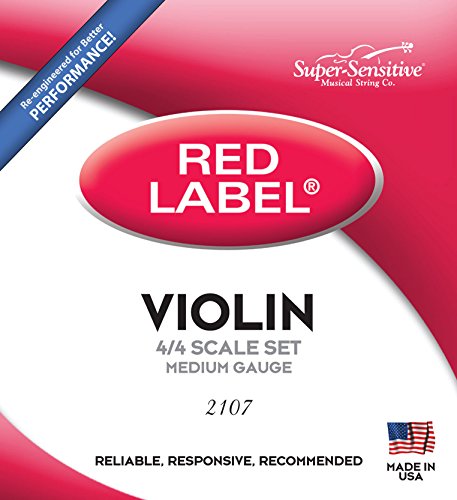
4. Super-Sensitive Red Label 2107, 4/4 medium
Super-Sensitive Red Label 2107 is the medium 4/4 student set reviewed here. It uses a solid steel core with nickel winding on the lower strings. ‘Super-Sensitive’ is the brand name, rather than a guarantee that the strings respond better than every other set. Red Label remains a practical steel option for a student instrument, particularly if your teacher already recommends this setup. Its straightforward construction and available replacement strings can make it easier to maintain a consistent school or practice instrument. Confirm size and tension before buying.
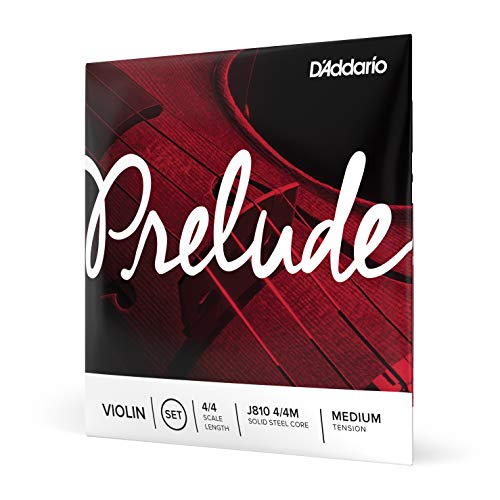
5. D'Addario Prelude J810 4/4M
D’Addario Prelude J810 4/4M is another solid steel option designed with students in mind. It offers a useful balance of durability, straightforward tuning and cost, rather than a guarantee that every beginner will prefer its sound. The medium set is an approachable starting point when your teacher wants steel strings and your instrument is already set up for them. Compare it with Red Label on fit, replacement availability and your teacher’s recommendation instead of relying on claims that one set is universally superior.
Prelude is sold in fractional sizes as well as full size, but each packet is intended for its specified instrument. The J810 4/4M listing here is the full-size medium set. D’Addario describes the core as solid steel; different windings on the A, D and G help achieve the required pitches. Sealed pouches protect the strings before installation, not indefinitely after use. Keep the strings clean with a dry cloth and replace a damaged or unraveling string promptly. No set can remove the need for correct setup, a suitable bow and regular practice.
Why Is It Important to Find the Right Violin Strings as a Beginner?
Learning the violin takes patience, and suitable strings can make the instrument easier to manage. They affect the sound and how the bow starts a note, but they do not determine how quickly you learn by themselves. A badly fitted string, unsuitable tension or poorly adjusted instrument can make practice frustrating. Start with strings that match your violin’s size and fittings, then ask your teacher whether the sound and response suit your current playing. A comfortable, predictable setup is more helpful than chasing the most expensive set.
Factors To Consider
Here are some valuable tips to help you find the ideal violin strings for beginners:
1) Know the Different Types of Violin Strings!
The three main core families are synthetic, steel and gut. Solid steel and stranded steel differ in construction and feel; both are found in student and professional sets. Gut strings use animal gut, sometimes with metal winding, and can require more attention as conditions change. Synthetic cores, often made from nylon-based materials such as Perlon, provide another balance of response and tone. Remember that a set may combine materials: a synthetic A, D and G can be paired with a steel E. Read the specification for each string instead of treating the whole set as one material.
2) Figure out Your Musical Preference!
Your musical interests can help narrow the choice, but there is no rule that classical music requires synthetic strings or that steel belongs only in fiddle music. Steel sets can offer a direct response that some players prefer, while synthetic strings are a common option when exploring a different tonal character. Your violin, bow and technique also shape the result. If lessons or an ensemble are your priority, start with your teacher’s recommendation and keep the setup consistent while you learn to control tone.
3) Know the Right Gauge and Tension!
Gauge refers to string diameter; tension describes the force the string exerts when tuned to pitch at its intended playing length. Diameter alone cannot tell you the tension or loudness of strings made with different cores and windings. Manufacturers publish tension specifications for particular sizes and pitches. Medium tension is a useful starting point unless your teacher or luthier recommends otherwise. Changing to a heavier set will not automatically improve projection, and using full-size strings on a smaller instrument can create the wrong playing tension.
So Which Type of Strings Should I Use as a Beginner?
You do not need the most expensive strings to learn well. Start with a correctly sized, dependable set that your teacher recommends and that you can afford to replace. Prelude or Red Label can be sensible steel choices; Dominant or Fiddlerman can introduce a synthetic lower-string set; Helicore offers a stranded steel alternative. More advanced violin strings may be useful later, but a higher price does not guarantee a better result on your instrument.
Learning to produce a steady tone takes time and regular practice. Let a new set settle before judging it, keep notes about response and tuning, and ask your teacher to distinguish a string problem from bowing or setup. If a string breaks repeatedly or the bridge moves as you tune, get help rather than solving the problem by buying another expensive set. When changing strings, replace them one at a time so the instrument remains under tension. A teacher or luthier can show you how to fit the ends and check the bridge safely. Consistent practice on a well-maintained violin is a better foundation than frequent changes of brand.