
Violinists strive to keep their instruments in peak condition, and choosing suitable strings is part of that care. Even a fine violin can lose clarity when its strings wear out. The right replacement interval depends on playing hours, string construction and signs of wear, rather than a fixed number of months.
Not all strings suit the same instrument or player. I recommend comparing the exact size, tension and end fittings before considering tone. The five sets below cover synthetic, steel and gut options, including a specialist five-string set. Experienced players often develop preferences that differ from a beginner’s needs, but a higher price alone does not make a set a better match.
The Best Violin Strings for Professionals & Advanced Player


Let’s look at the full list.
Key features: Full 4/4 medium set; synthetic A, D and G; aluminum-wound A, silver-wound D and gold-wound G; stainless-steel ball-end E. The gold-G, ball-E packet is Pirastro 415021.
The Pirastro Evah Pirazzi Gold set is my choice here for a player seeking a full synthetic-core setup with a gold-wound G. Pirastro offers a separate silver-G version, so check the packet rather than buying on the family name alone. The lower strings use a synthetic multifilament core, while the E is steel. This is a current alternative to the original Evah Pirazzi range, not a correction of a defective older set. Its tonal character will still depend on your violin and bowing.
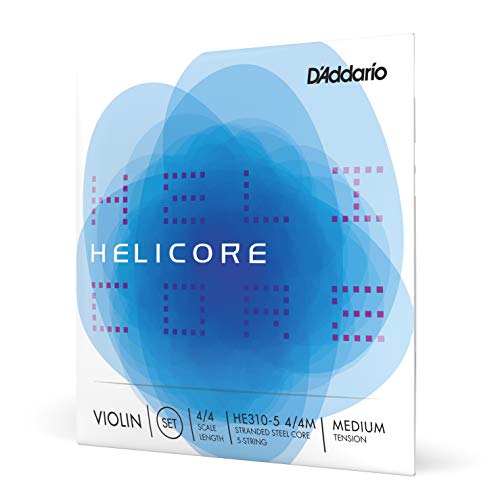
Key features: D’Addario HE310-5 4/4M; full-size, medium-tension five-string violin set; stranded-steel construction; includes a low C string.
The D’Addario Helicore five-string set is the specialist option on this list. Its low C is intended for a five-string violin, so it is not a like-for-like four-string replacement. Check the complete HE310-5 4/4M model code: the heavy-tension set and ordinary four-string Helicore sets are different products.
Helicore is worth considering for a player who wants a steel-core setup for fiddle, folk, country or other amplified and acoustic styles. Those uses do not exclude classical players who prefer its response. The important starting point is a five-string instrument set up for this scale and tension, rather than choosing it because it is described as professional.
The extra low C expands the usable range, but it also makes this an unsuitable default recommendation for a standard four-string violin. If you only need E, A, D and G, compare the corresponding four-string set instead. Do not substitute heavy tension merely because the medium packet is harder to find.
Key features: Pirastro Obligato 411021; 4/4 medium set; synthetic A, D and G; aluminum-wound A, silver-wound D and G; goldsteel ball-end E.
Obligato is the synthetic option I would consider when a player wants a warmer tonal direction without moving to gut lower strings. Pirastro describes its core as a synthetic multifilament material. The standard set pairs that core with a goldsteel E, so the reference to gold describes the E string treatment, not a gut core or a gold-wound G.
This set can suit solo and ensemble work when its response complements the instrument. It is also a useful comparison with Evah Pirazzi Gold: both use synthetic lower strings, but their winding combinations and tonal aims differ. Choose the specified ball-E set only if it matches your tailpiece or fine tuner; the loop-E and plain-steel-E variants should be treated separately.

Key features: Pirastro Gold Label, 4/4 medium; gut-core A, D and G; aluminum-wound A and silver-wound D/G; steel ball-end E. The lower-string end fittings differ from the E.
Pirastro Gold Label is the traditional gut option here. The A, D and G are made around sheep gut, not a modified synthetic fibre. The steel E is a separate construction. That distinction matters when comparing it with Evah Pirazzi Gold: the word Gold appears in both names, but these are different string families with different playing and maintenance demands.
I would choose Gold Label for a player who already wants to explore gut lower strings and is comfortable monitoring tuning as conditions change. It is less convenient when the priority is the stability of a synthetic or steel setup. Match the ball-end E and the lower-string fittings to the instrument, and ask a teacher or luthier for help if you are changing core type for the first time.

Key features: Thomastik-Infeld Vision VI100, 4/4 medium; synthetic-core A, D and G; aluminum-wound A and silver-wound D/G; tin-plated carbon-steel E with removable ball.
Vision VI100 is a straightforward synthetic set from Thomastik-Infeld in Vienna, Austria. The VI100 set contains VI01, VI02, VI03A and VI04. Those codes help distinguish it from other Vision combinations, fractional-size sets and the separate Vision Solo range. Its steel E has a removable ball, which can be useful when matching the set to different fine tuners.
I would consider this set for an advancing player who wants a clearly specified synthetic setup without moving to gut. Individual strings can be replaced as needed, but mixing strings from different ranges changes tension and balance. Start with the matched set, listen to the result on your own violin, and make selective changes with a teacher or luthier if one string needs a different response.
Professional Violinist String Requirements
Not all strings are alike, and the string type affects your sound. It’s crucial for a violinist to use the right strings for the situation.
- Soloist: Professional soloists needed a sound that can be heard easily when handling numerous overtones. That should be able to amplify the tones smoothly when playing on an outdoor arena.
- In a Band: The clashing of sounds can be expected when different instruments are played with a professional band, and a violinist should overcome. The violin sound should be able to penetrate and be heard above other instruments being played simultaneously.
- Part of an Orchestra: In an orchestra, the ultimate goal is to play harmoniously with other players. There is no need to command attention by playing aggressively to be heard over the other instruments. Blending the sound of the violin to the whole orchestra should require great control over volume.
Buyer’s Guide: Tips in Strings Longevity and Replacement
Most professional violinists discover their personal preferences during their musical journey. Experience is the greatest teacher.
Don’t replace your violin strings on your own if it’s your first time. Have someone experienced guide you through the process.
Replacing the strings is a straightforward process. However, if done incorrectly, it can produce unwanted sound and damage the violin.
Check the strings often for wear or fraying, especially with regular use.
Strings can last longer with infrequent playing, but always check them as some don’t handle extreme temperature changes well.
For a long break, ask a luthier how to store your particular instrument. Do not routinely loosen all the strings to extend their life: changing the instrument’s tension can disturb its setup. Keep it in a suitable case away from heat and large humidity changes, and inspect the strings before returning to regular playing.
If you’re unsure, I recommend talking to a violin teacher or technician.
- Seek experienced guidance for first-time string replacement
- Regularly check for wear and fraying
- Ask a luthier about storage during long breaks
Phyllis Gonigam says
The A string on my violin came unwound and had to be removed. The existing strings are OK but have been on so long that I don’t remember which brand they are. One of the strings was borrowed from another violin but is still okay. They are gut-core. Which brand to you recommend?