
A drummer’s music stand needs to put the score where it is easy to read without getting in the way of sticks, cymbals or pedals. The right mounting style matters more than choosing the same stand a standing instrumentalist uses.
Music stands support sheet music in rehearsal rooms, orchestras and home practice spaces. For a drummer, the desk also needs to hold the number of pages you use while leaving a clear view of the kit and, when needed, the conductor. A clamp-mounted desk and a freestanding stand solve that problem in different ways.
Most ordinary stands can hold a score, but their legs may compete with drum hardware. You cannot always rearrange a kit around an awkward base. Check the position from your playing seat, including where the desk sits during fills and how easily you can reach a page turn.
I have chosen five options that cover attachment to existing hardware, a dedicated rehearsal stand and portable use. Start with the type of mount your kit can accommodate, then compare desk size and the amount of music you need to carry.
The choices below are assessed around positioning, portability, stability and durability. Those priorities can pull in different directions: a rigid rehearsal stand takes more transport space, while a compact stand needs careful setup with a heavy book.
The Best Music Stands for Drummers
Disclosure: This post contains affiliate links, meaning I may get a commission if you make a purchase through my links, at no extra cost to you. As an Amazon Associate I earn from qualifying purchases.
I’ve picked the best music stands for drummers for you.

The Manhasset 53DH is the specialist hi-hat-mounted choice. Its desk can sit above the hi-hat area, bringing the chart closer without adding another floor base. I would choose this arrangement when the left side of the kit offers a clear sightline and there is enough stick clearance around the cymbals.
Check the available mounting space and the movement of the hi-hat before fitting it. A position that is comfortable while sitting still can interfere with a cross-stick movement or a fast reach. The music desk should remain independent of the pedal’s moving parts.
The model uses a full-size desk with a clamp and swivel arrangement for positioning. That is useful when a normal stand base would have to sit outside the kit. A heavy score also adds load to the supporting hardware, so tighten the clamps correctly and test the complete setup before a performance.
This recommendation is the 53DH. Do not assume it includes the wider four-panel desk associated with a different Manhasset model. Choose it for its mounting position, then check whether the desk accommodates the number of pages you read at once.
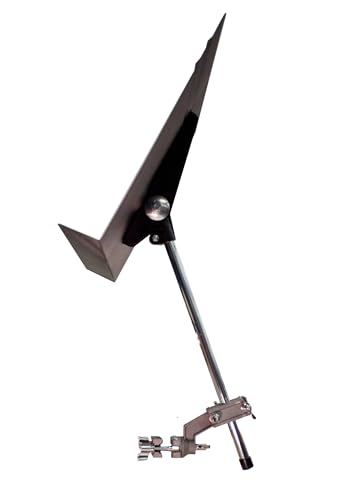
The Manhasset 53D provides a clamp-mounted desk for a drummer who wants more freedom over where it attaches. It is worth considering when a hi-hat-specific position is inconvenient and compatible stationary hardware is already close to your preferred reading angle.
Its mounting arrangement attaches to suitable drum hardware rather than requiring a separate floor base. Clamp it to the appropriate support tube, not directly to a drum shell or an unsuitable moving part. Check tube size, grip and desk clearance before assuming any part of the kit will work.
I would choose the 53D for a jazz or ensemble setup where reading the score and watching the conductor are both important. The desk can be positioned around existing hardware, but the usable angle depends on your kit. Test the view from your actual seat instead of judging it from the front of the drums.
The trade-off is that the stand relies on another piece of hardware for support. A separate rehearsal stand may be more convenient if the kit changes frequently or several players share it. Keep the clamp parts with the desk when transporting it so the mount is ready at the next setup.

The Manhasset 48 Symphony is my freestanding choice for a rehearsal room or home practice space. The single-stand package is distinct from Manhasset’s multipacks and short- or tall-shaft variants. Its rigid desk and fixed three-foot base suit a stand that will stay assembled between sessions.
It uses an aluminum desk and a steel base. That construction is useful for ordinary scores and books, but it takes up more storage and vehicle space than a small folding stand. I would choose it when consistent positioning matters more than packing the stand into a narrow bag.
The familiar friction-adjusted shaft and tilting desk allow height and reading-angle changes without a separate desk clamp on the kit. Set the music where your eyes can reach it without forcing your neck to turn away from the playing position.
Check how the base fits between cymbal stands and pedals. A freestanding stand is independent of the drum hardware, which makes it easier to move between players, but its footprint may be awkward in a small kit layout. Keep all three feet fully supported on a level surface.
This is the full floor stand, not a tabletop desk or an accessory shaft. Verify the exact package before ordering. For regular transport, compare its rigid shape with the two portable choices below and allow enough room to protect the desk from bending.
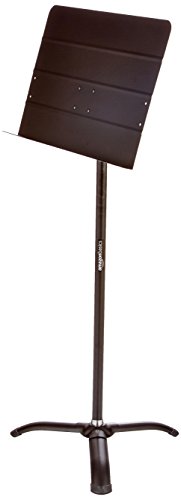
The Amazon Basics SMS088 is the straightforward portable alternative here. It is a metal sheet-music stand with adjustable height, suited to taking a modest score to practice or rehearsal when a full rigid stand is awkward to carry.
I would choose this style when you want a stand that can be moved independently of the kit. Position it before adding books or loose sheets, then check that the desk and adjustment points are secure. A portable stand should not be treated as a shelf for unrelated equipment.
Its height adjustment helps place the music for a seated drummer, but check the lowest usable position and the desk angle against your kit layout. Measurements can refer to different parts of a stand, so compare the actual music position rather than relying only on maximum height.
The base still needs floor space around the pedals and hardware. Open it properly and keep the score within the desk’s supported area. A rigid Manhasset makes more sense for a permanent room; this is the option I would compare when transport and easy repositioning are the priorities.

The GLEAM GMS-88 offers a portable alternative with a carrying bag and a desktop-use option. I would consider it for a drummer who also studies charts away from the kit and wants one stand that can be packed between sessions.
The adjustable support and tilting desk let you work toward a comfortable reading position. Check the exact listing for the size of the desk and its supported height range; the GMS-88 identity matters more than specifications from another GLEAM stand with a similar name.
The carrying bag is useful when the stand travels with you. Pack the desk and moving parts carefully, and check the adjustment knobs after transport. Light stands are easier to carry, but heavy books or an extended desk can make balance more demanding.
Set the desk angle so the pages stay supported and the chart remains clear of the sticks. I would choose this model for portability and flexible study use, while choosing the rigid Symphony stand for a room where the stand rarely moves.
Buyer’s Guide: Factors That May Influence Your Choice of Music Stands
As a drummer, you need to consider a few key variables when choosing a music stand. Here are the important factors:
Portability
I can’t stress this enough: your music stand’s portability is crucial. Consider where you’ll use it and whether you’ll need to move it frequently.
If you travel often and want to take your stand with you, choose a more portable option. Foldable models offer the best convenience for handling and transportation.
Stability
Consider another factor when picking a music stand. Can it hold your music sheet or book without wobbling? Check if it has a stable support column and base.
Check stability with the actual book or folder you use. A portable stand can work well when it is opened correctly and positioned within reach; do not assume a material or appearance alone guarantees that it will stay steady.
Flexibility
As a drummer, you want to stay comfortable while playing. The wrong music stand can ruin this experience. This is why a flexible stand, which you can easily adjust to meet your needs, is crucial.
You need a product with an adjustable height and a tiltable bookplate. This will help you find a comfortable balance between playing your drums and checking your sheets.
Durability
The last important factor on my list of the best music stands for drummers is durability. You don’t want to replace music stands as often as your drumsticks.
A durable stand should have sound joints, secure clamps and a desk that suits its regular load. Inspect those parts as the stand ages, especially after transport. Choosing the right mounting type and treating the adjustment points carefully will matter more than a promise that every stand will last for years.
Ryan says
I purchased Simple Song and 80s Rock for beginning drummers to learn. Some of the sheet music is 3 to 5 pages. How do you do that on a music stand or flip page and keep playing? I’m missing something here.